Guido has lived in Munich for almost 40 years. He has been with his partner for just as long. Born in Belgium, he was previously briefly married to a woman, but then came out. As a gay activist, he was also on the board of the German AIDS organisation Deutsche AIDS-Hilfe. When he was diagnosed with HIV, the 68-year-old asked himself one question in particular: Will my partner be able to forgive me? A conversation about living with HIV, sexuality in old age and the fear of dying.
The diagnosis was not the biggest shock
Guido, can you still remember the time of your HIV diagnosis?
Yes, that was in 1998, when I was suddenly in very poor health. I could hardly breathe and had a few other complaints, so my GP sent me to an internist who carried out a rapid HIV test. The result was positive.
How did you feel at that moment?
Of course it was more than unpleasant, but somehow it didn't feel quite so dramatic, which was due to the fact that considerable progress had been made in HIV therapy since 1996. In this sense, the diagnosis didn't lead to a death shock and the most important question was not: Will I die soon?
What was much more dramatic was that I had to tell my partner about it. I had to confess to him that I had been infected outside of our relationship. That was my main problem, which also made me feel guilty for a long time. Fortunately, I didn't infect him.
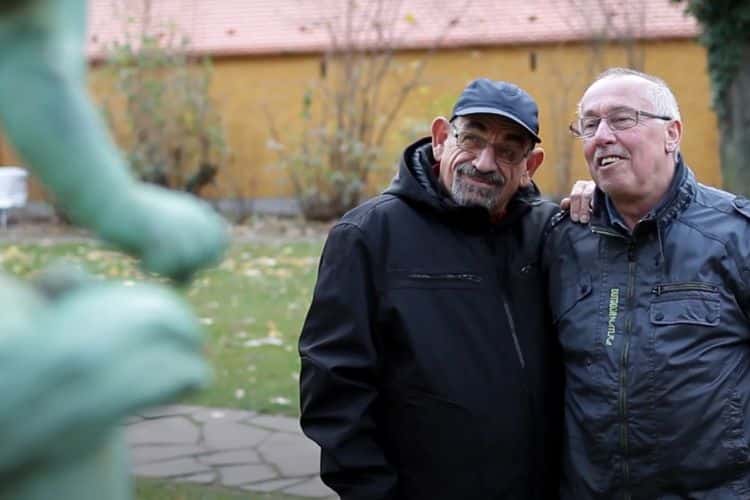
How did your partner react at the time?
He said to me quite succinctly: "Nothing will change between us. I've never received a greater proof of love in my life.
Do you actually know how you got infected?
No, I couldn't reconstruct afterwards how, when and with whom it happened. I also felt very miserable about it.
Living openly - but not with everyone
Have you told friends and family about your infection?
That was a bit difficult. On the one hand, I was on the federal board of Deutsche AIDS-Hilfe at the time and felt the responsibility to publicise my infection. I did that to some extent. On the other hand, I didn't want to tell God and the world about my infection; I didn't talk about it with my family, for example. It was difficult enough for my parents to have a gay son in the first place.
And what feedback did you receive from those you introduced?
My circle of friends was relatively relaxed. I found out in a roundabout way that some people were worried about me, but they didn't have a problem and behaved completely normally towards me. The fact that I didn't experience any discrimination at all is certainly also due to the fact that I was in an appropriate environment, both as a gay activist and as an HIV counsellor and board member of the German AIDS service organisation.
Professionally, however, I remember exactly when my boss at the time said, even before my own diagnosis, that he would rather not shake hands with gay people now.
Today it's all about getting older
What does your HIV status mean to you today?
HIV is the smallest problem I have. The viral load is undetectable, the helper cells are in the normal range. All the other illnesses are much worse. I have high blood pressure, diabetes, my kidneys are broken and I'm on dialysis.
I don't know what proportion of this is due to HIV or the medication and what is due to age itself. But it's also pointless to speculate. The loss of libido, which is also caused by the medication, is a completely different issue.
What do libido and sexuality mean to you?
I know that many people will protest now, but the fact is that sexuality becomes less important with age. For me at least, sex became less and less interesting as I got older. I used to live a very active and pleasurable sexual life. The urge to experience a lot now is simply no longer there. When I see others who act like professional youths, I always feel a bit ashamed of myself.
Are you afraid of the future?
Well. I'm now 68 years old and just starting to plan my 70th birthday, which I'm really looking forward to. But: I'm also afraid, especially of becoming a care case. Will I no longer be able to wash myself or go to the toilet? For me, it's not actually death that's the problem, but the path to it, the slow dying. Then there's the fear that my partner could go before me. That would be really bad.
Looking at today: Where do you stand in life?
Overall, I'm doing very well. I'm very happy that I've had my partner for 38 years, so I don't have the typical age-related problem of loneliness. What's more, we do a lot with other people. But that's also because we've never cut ourselves off from our surroundings. We have a regular gay and lesbian get-together and we go bowling once a month with another clique. So we really don't know loneliness at all.
Living with HIV: Guido in the video
In the video, Guido talks openly about the moment of his HIV diagnosis, about feelings of guilt and about his partner's reaction, which is still very important to him today. He also talks about how his view of HIV, health, sexuality and ageing has changed over the years.
Further perspectives on ageing
Here you will find more interesting articles about ageing, health, relationships and life as a gay man.

Need someone to talk to?
Whether acute or simply for orientation - sometimes it helps to talk to someone in confidence.
Use the Gay Health Chat - the button at the bottom right will accompany you on the page. There you can chat anonymously and free of charge:
- Personal live advice in the chat
- Help by e-mail or telephone
- Information on health, law, everyday life and more