Why queer people vote for far-right parties
From Ernst Röhm to Peter Thiel: even though the majority of queer people do not vote for right-wing extremists, there are always counter-examples. Why? What makes queer people vote for far-right parties or even join them? Our author Mathias Foit has its Doctoral thesis has written about this topic and provides answers here.
Queer shift to the right? In the last 10-15 years, right-wing populism and right-wing extremism have experienced a particularly strong resurgence worldwide and have permeated many parts of society. Time and again, the media report in apparent bewilderment that LGBTQIA+ people - in theory the most cosmopolitan, tolerant group in society - are turning to far-right, nationalist parties, be it the Rassemblement National in France or the Republicans under Trump. These parties are either blatantly anti-queer or declare - more or less officially - their intention to curtail the rights of various queer groups.
As surprising and contradictory as this phenomenon may be, it is not new in modern history. In the following article, both historical and current examples from a number of countries - particularly Germany, but also the USA, France and Poland - are cited for the intertwining of queer desire and queer politics on the one hand and nationalism and right-wing extremism on the other. It not only examines the reasons why queer people vote for far-right parties, but also what consequences this has for today's politics and what lessons can be learnt from this.
"The warm brotherhood in the brown house": the circle around Ernst Röhm
In the early 1930s, even before the Nazis seized power, Ernst Röhm, leader of the Sturmabteilung (SA) and one of the most important figures in the NSDAP, became the "hero" of a widespread smear campaign: he was outed as a homosexual. Rumours about his sexual "excesses" had been circulating for years beforehand, and he was also a member of the Bund für Menschenrecht (BfM), the largest national umbrella organisation of so-called "friendship clubs" in the Weimar Republic.
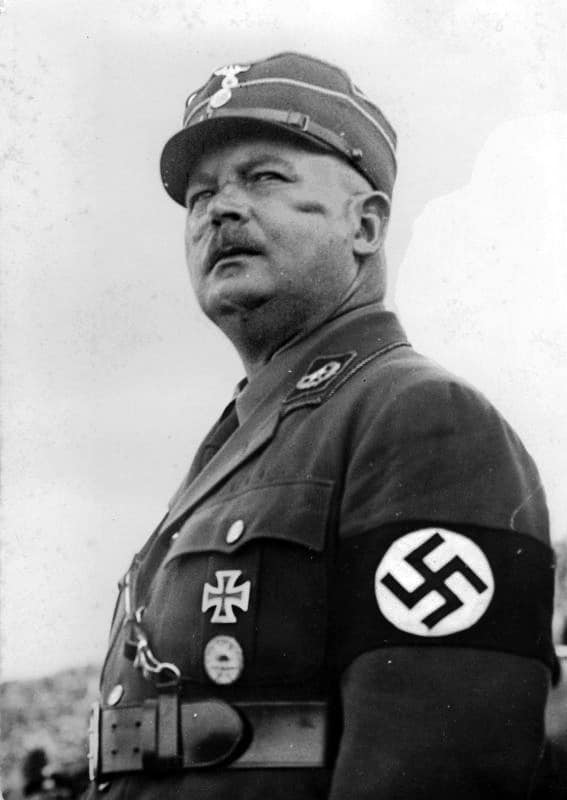 Ernst Röhm - Photo: Bundesarchiv, Bild 102-15282A / Georg Pahl / CC-BY-SA 3.0, CC BY-SA 3.0 DE , via Wikimedia Commons
Other SA functionaries were also known to be homosexuals, such as Helmuth Brückner, the Chief President and Gauleiter of the province of Lower Silesia, as well as his deputy and the police chief of Breslau, Edmund Heines, whose "nocturnal orgies" and "wild parties with young men" were reported by the writer Walter Tausk in his diary. The Social Democratic press in particular mocked the conflict between the NSDAP's official party line on homosexuality and the open tolerance of homosexuals within its own ranks. The Munich Post spoke of a "warm brotherhood in the brown house".
Hitler knew about the homosexuality of Röhm and his many followers. Why he tolerated them for so long, how he reconciled this with the Nazi Party's official position on "unnatural fornication" and what the main reason was for the murder of numerous party comrades at the end of June and beginning of July 1934, which has gone down in history as the "Röhm Putsch", remains the subject of historical debate. Both Röhm and Heines fell victim to the bloody purge.
Thanks to a great deal of research, we now know that the anti-homosexual crusade conducted with such vehemence was not a minor issue, but a central component of the Nazi conservative revolution. It is therefore quite possible that the Röhm murders were in fact primarily aimed at destroying a clique of homosexuals who were perceived as dangerous and inclined to conspire against the state. On the other hand, it is also conceivable - as many historians believe - that Hitler wanted to remove what he saw as his greatest rival and his circle from the path to sole rule in the NSDAP.
The roots of queer right-wing extremism
There were also attempts at rapprochement with the Nazis on the part of the then active "homosexual movement" in the person of the chairman of the aforementioned League for Human Rights, Friedrich Radszuweit. In August 1931, he wrote an open - and ultimately unanswered - letter to Hitler personally, in which he called on the NSDAP leader to revise his position on homosexuality. Radszuweit also criticised the smear campaign against Röhm, although his criticism was essentially directed more at the instrumentalisation of homosexuality as a political weapon than at defending the SA leader.
The extent to which Radszuweit's ingratiation with the Nazis is evidence of his supposed change in values or opportunism, or a desperate attempt to negotiate with the devil, is still the subject of controversy today. The fact is that by the end of the 1920s, around 30% of the BfM membership had already declared themselves to be supporters of the Nazi party. Whether Radszuweit wanted it or not, the growing support for the NSDAP, even within the BfM's own ranks, could not be overlooked.
In general, conservatism, nationalism, right-wing populism and right-wing extremism were by no means marginal phenomena in the history of the first German "homosexual movement". Magnus Hirschfeld, who is generally celebrated as the spiritual father and unofficial leader of the movement, was one of the most vocal advocates of the First World War and published two writings (one of them with the telling title "Why do the nations hate us?") in defence of German imperialism. It was only in the later years of the war that he turned to pacifism and internationalism. Adolf Brand, chairman of the Gemeinschaft der Eigenen (GdE), which celebrated the love of men and "boys", and informal spokesman for the circle of so-called "masculinists", was a die-hard anti-feminist, anti-Semite and a relentless critic of the Weimar Republic and advocate of anti-democratic, arch-conservative politics.
The strange paradox: rights and homonationalism
The current entanglement between LGBTQIA+ and nationalism is often referred to as "homonationalism". This involves the instrumentalisation of homosexuality for nationalist, racist purposes and the playing off of queer groups (mostly cis-male, white gays) against the "others". Right-wing politicians, for example, try to fuel the fear of the former against the latter in order to win votes, in particular by drawing on the image of the fundamentalist, homophobic, mostly Muslim immigrant.
This leads to an even greater balancing act than with the Nazis: today's right-wing extremists sometimes present themselves as the supposed protectors of a social group that other right-wing extremists want to see in prison and in turn blame others for the alleged sexualisation of children.
Homonationalism "Around the World"
There are examples of homonationalism all over the world. In 2016, the Islamophobic, "white supremacy" preaching and transphobic organisation "Gays for Trump". Back in 2005, the historian Paul Robinson wrote in his book QueerQueer is a collective term for people whose sexual orientation or gender identity does not conform to the social norm of "heterosexuality". Mehr Wars described how conservatism has divided the LGBTQ+ public in the United States since the beginning of the gay liberation movement. In France and the Netherlands, the far right is also gaining support among many LGBTQIA+ people. In the 2017 presidential election, Marine Le Pen was already primarily in favour of white, cis-male homosexuals. a reasonable political alternative.
Interestingly, the recourse to patriotism or nationalism by queer people does not necessarily have to be motivated by Islamophobia or racism. In Poland, for example, the controversy surrounding the display of the national coat of arms and the national flag against a rainbow background at some CSDs in 2018 also sparked a debate within the LGBTQIA+ community there. Many saw this as an effective political strategy for recognising membership of the national community. Others were strongly opposed to national pride due to the institutional queerphobia of the government at the time.
The most important question: why?
The reasons for the apparent contradiction between emancipatory endeavours and far-right, nationalist and very conservative politics naturally vary depending on the case and context.
In the German Empire, for example, the whole of German society was strongly nationalistic and conservative, which went hand in hand with the imperial and militaristic basic orientation of the state; after all, it was European nationalism that led to the First World War.
In the Weimar Republic, widespread national resentment, the humiliation of the lost and a longing for the old order also played a role. In addition, queer people, who were repeatedly denied their civil rights and accused of treasonous tendencies, fought to be recognised as respectable, dutiful and loyal citizens. A similar motivation - albeit in a very different, largely simpler socio-political and legal context - drives many LGBTQIA+ people in Poland today.
Significantly, it is predominantly cisgender men who continue to form the political vanguard of right-wing extremism, right-wing populism and nationalism. This is hardly surprising, as they have always been denied masculinity and the associated qualities such as strength, determination and efficiency. Professing to be a patriot or even a nationalist often means asserting oneself as a "real" man.
As has been shown, a common denominator of the different forms and national variations of homonationalism today is often Islamophobia. Far-right parties cynically exploit the fears of some LGBTQIA+ people to gain votes and argue against the immigration of people - including queer people who could find refuge in Germany - from Muslim-majority countries.
And what now? Consequences for politics
Homonationalism makes it clear that social concepts such as gender or nation(ality), which are questioned today - for good reason - still have a significance for many LGBTQIA+ people that should not be underestimated. Getting rid of these categories, which is desired by parts of society, is therefore a greater challenge than expected and requires creative approaches.
Homonationalism also shows the importance of integrating anti-racism into queer, emancipatory politics and education. Stereotypes and prejudices against "foreigners" are also widespread in the LGBTQIA+ community. Refugees, but also queers of colour, have been particularly affected by the right-wing truck of recent years, which is why they deserve the solidarity of the entire community.
The inconsistency and cynicism of far-right parties in dealing with homosexuality and gender diversity is obvious. What many queer people hope will be an improvement can only end as it did almost a hundred years ago - with disappointment and misery.
More on this topic can also be found in the article "Queer Nazis" of the Siegessäule magazine.
Bibliography
- Bauer, Heike. "The Hirschfeld Archives: Violence, Death, and Modernity QueerQueer is a collective term for people whose sexual orientation or gender identity does not conform to the social norm of "heterosexuality". Mehr Culture." Philadelphia, Pennsylvania: Temple UP, 2017.
- Bruns, Claudia. "Politics of Eros: The Männerbund in Science, Politics and Youth Culture (1880-1934)." Cologne: Böhlau Verlag, 2008.
- Foit, Mathias. "QueerQueer is a collective term for people whose sexual orientation or gender identity does not conform to the social norm of "heterosexuality". Mehr Urbanisms in Wilhelmine and Weimar Germany: Of Towns and Villages." Cham, Switzerland: Palgrave Macmillan, 2023.
- Marhoefer, Laurie. "Sex and the Weimar Republic: German Homosexual Emancipation and the Rise of the Nazis." Toronto: University of Toronto Press, 2015.
- Micheler, Stefan. "Magazines, associations and clubs of same-sex desiring people in the Weimar Republic." Stefan Micheler Homepage. August 1, 2008. www.StefanMicheler.de/zvlggbm/stm_zvlggbm.pdf.
- Vendrell, Javier Samper. "The Seduction of Youth: Print Culture and Homosexual Rights in the Weimar Republic." Toronto: University of Toronto Press, 2020.
- Wolfert, Raimund. "On the trail of the 'inverts' in Wroclaw in the twenties and thirties." Invertito Yearbook for the History of Homosexuality 9 (2007): 93-135.
- Zinn, Alexander. "Removed from the body of the people? Homosexual men under National Socialism." Frankfurt: Campus Verlag, 2018.