Protest for safe space for sex work in Berlin
It is February 2025. A grey afternoon. People gather on Goebenstraße in Berlin with a banner, high-visibility vests and red umbrellas. About twenty people have come, sex workers...members and supportersSome of them are holding up signs. „Full decriminalisation now,“ they say, „Support your local sex workers.“.
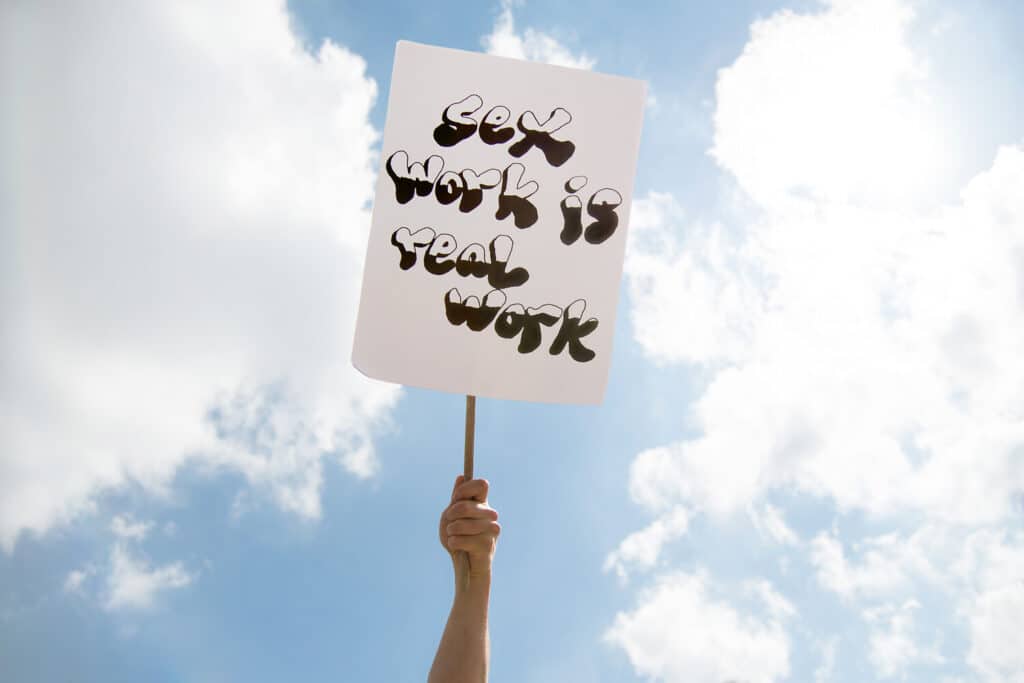
They are standing in front of the office of the Berlin municipal housing company Gewobag to protest against the sudden closure of Café Julia, a night café for sex workers. „We have been planning this space for years, which is not only intended to offer advice and resources, but also to be a safe place for people who are repeatedly marginalised,“ says one of the speeches.
Café Julia was a dream that almost became reality. Funding from the Senate had also been promised. Cooperation with the Berlin City Mission, which would have run the corner building near Berlin's Frobenstraße during the day, had already been agreed. The sex workers wanted to open it at night, in line with the needs of street workers.
Kurfürstenkiez: The daily working life of sex workers
Frobenstraße is a side street in the red-light district of Kurfürstenkiez. Kurfürstenkiez has never been an easy place, but in recent years the pressure has increased noticeably. With rising rents and ever-new construction projects, hostility towards those who have to work in this area is also growing. Where neighbours used to greet each other or at least look away, today there are more frequent reports, complaints and night-time police checks. At the same time, there is a lack of low-threshold places that could provide security. While sex workers stand visibly every few metres on the busy Kurfürstenstraße to solicit their clients, the location on Frobenstraße is much more secluded. This street is the workplace of trans women.

A designated place in public space can have advantages. Customers who want to meet a trans woman know that they can get to know her there. They can support each other and kill time together while waiting. Visibility in this place means finding each other.
Visibility in sex work: between protection and violence
At the same time, visibility is a danger. In the book Trap Door: Trans Cultural Production and the Politics of Visibility, published in 2017 by Tourmaline, Eric A. Stanley and Johanna Burton, the visibility of trans people, which has increased in a completely new way worldwide since the 2010s, is described as a trap door. Not like a door you can walk through, away from one place and towards another, perhaps more beautiful place. But rather a trap that can rob you of the solid ground beneath your feet at any moment.
Sex workers on Frobenstraße are confronted with verbal abuse, threats and physical violence. They repeatedly report that groups of men deliberately drive past them in cars to throw bottles at them and shout insults. This is only possible because of their specific visibility, a hypervisibility that they experience as trans women who work in the sex industry and depend on public spaces as their workplace. Visibility without protection, without resources, is dangerous. The latest figures from Trans Murder Monitoring by the organisation TGEU (Trans Europe and Central Asia) show that sex workers account for 34% of trans people murdered worldwide this year.
Separate rooms for trans* sex workers: More than just a café
For this reason, Trans foughtSexworks, a Berlin-based group of transSex workers, for as long as they need, for a space that they can manage themselves and design according to the needs of their own community. The Gewobag property would have been within walking distance of the trans* streetwalking area and would have served not only as a café, but also as a place to do laundry and shower, as a refuge from violence and as a place for socialising. Everyday necessities for a dignified life that cannot be taken for granted by trans* sex workers.
It is not only poverty that makes it difficult for them to access safe spaces. Lack of documentation, racism, gaps in their CVs and transphobia also play a role. Even those who can afford to visit a café are not welcome everywhere or feel comfortable there. The stigma attached to prostitution permeates society as a whole. It makes spaces for those who are particularly hard hit small and rare.
Gewobag advertises the capital's „diversity“ online. Nevertheless, after agreeing to the project, it suddenly rented its premises to another interested party. Now a dental laboratory is to move in there. This company does not depend on the location near the red-light district. However, it brings a clean image to the neighbourhood.
Anyone looking for explanations will quickly suspect that Gewobag used Café Julia as a speculative wild card in order to achieve a higher rent. What really happened remains unclear.
When sex work disappears from the internet: censorship on social media
The rally to protest against the shattered dream of having their own space is one of the last major actions that transcould make sex work visible. The Instagram account, which has over 10,000 followerswhich was internationally networked and provided users with education, empowerment, donation opportunities and community, was blocked in August by the Meta-owned platform without warning and, of course, without justification. A request to review the decision remained ineffective.
Sex workers have always had an ambivalent relationship with social media. They were pioneers on almost every platform.Once established, they made themselves attractive to a broad audience through their content, as in the case of Tumblr or Twitter, and had a particular influence on financing models (example: Onlyfans). In 2022, the European Sex Workers Rights Alliance (ESWA) showed in a study that platforms systematically impose shadow bans on sex workers and delete their accounts.
„Censorship is not limited to images or sexual content. Even educational, political or activist posts are often flagged and removed. Terms such as „sex work“, „OnlyFans“ or „escort“ are automatically flagged by moderation algorithms – regardless of the context in which they are used. This means that simply recounting your own life experiences, advertising a legal service or posting about human rights can be grounds for deletion. This was written by Yigit Aydinalp, programme director at ESWA, in an open letter to Meta in May 2025.
This censorship also affects individuals, groups and associations in countries where sex work is legalised or decriminalised. The corporation is thus placing its own moral values above local laws and exporting the criminalisation of sex work from the US to Europe.
When an account is deleted, years of shared knowledge often disappear. Warnings about dangers, legal advice materials, information for migrants, art projects, expressions of grief and community history are then gone. Everything is deleted with a single click.
Sex workers cannot present themselves online as individuals, nor can they express their personalities, dreams and destinies. They are also not allowed to stand up for themselves or participate in political discourse.
Platforms, profits and rights of sex workers
Even in Germany, where sex work is legal under certain conditions, a few tech companies dominate the virtual space that sex workers can use. The platforms are characterised by high fees, poor service and prioritising the egos of customers over the safety of sex workers. Added to this are the stigma attached to prostitution in language and structure and a lack of opportunities for users to have a say. There is a lot of money to be made from them as long as hardly anyone is interested in the injustices they face.
Who talks about sex work – and who is silenced?
Paradoxically, the media, both social and traditional, are full of the topic of sex work. Sex sells, and selling sex sells twice as well. Talking about sex workers is permitted, rewarded, and has fuelled many a journalist's career. This year, too, the community was not spared a debate on the criminalisation of sex work in Germany.
It doesn't matter who has the better arguments or the lived experience. The space in which the debate is held only allows for one of the many perspectives on the topic: the perspective of those who do not share spaces with real sex workers. It's convenient to talk about a group that cannot respond. That way, you don't have to worry about precision, equality or respect for that group.
Despite everything: sex workers are creating space for themselves
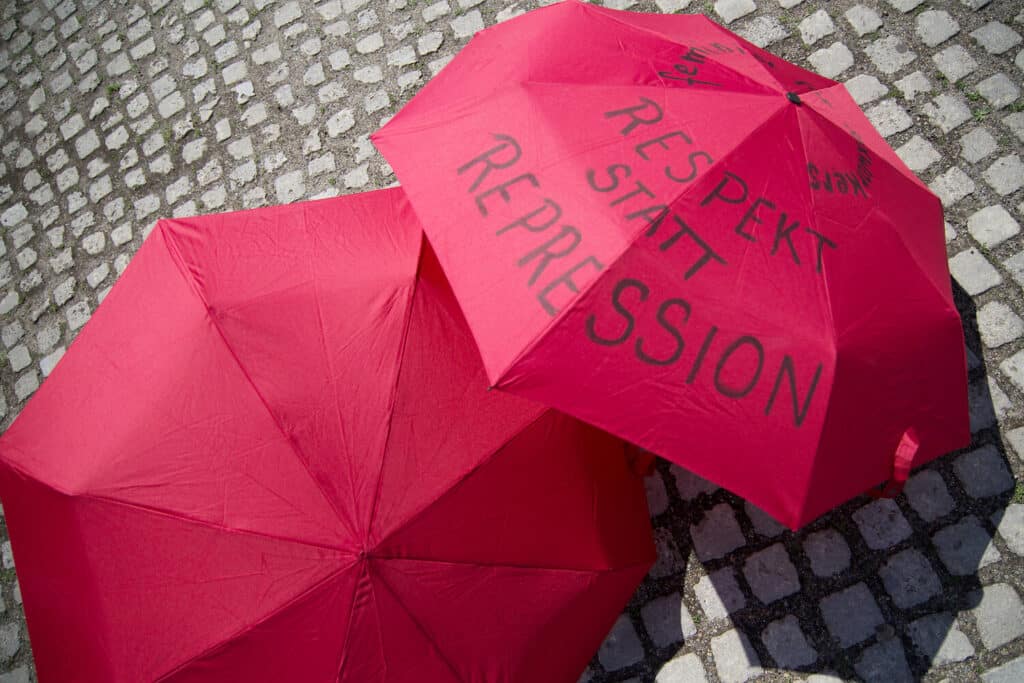
On the way back from the rally, the red umbrellas look like small, defiant dots in the grey cityscape. Yes, Café Julia was prevented from opening. Yes, TransSexworks was silenced by Meta. And yet the group continues to search for opportunities for their self-managed space in the Kurfürstenkiez neighbourhood. And yet there is already a new Instagram account and, moreover, a new website that will enable documentation and networking independent of Meta & Co. in the future. This community cannot be deleted. There is no world without sex workers.
FAQ: Frequently asked questions about sex work, rights and safe spaces
Here we answer key questions about sex work, the working conditions of sex workers, and the challenges that trans people in particular face in this profession. The FAQs provide guidance and background information on rights, safety, and social debates.
Sex work refers to voluntary sexual services provided in exchange for payment. The term emphasises that this is gainful employment and not exploitation or coercion.
Sex work is work because it requires effort, time, physical presence and professionalism. Sex workers earn their living from it and, like other professions, need protection, rights and safe working conditions.
Trans sex workers often experience multiple discrimination. Transphobia, stigma and social exclusion increase the risk of violence and lack of access to safe spaces.
The red umbrella is the international symbol of the sex work movement. It stands for protection, solidarity and the demand for rights and decriminalisation.
Many trans people end up in sex work because they face severe discrimination in the regular job market. A lack of documentation, trans misogyny, gaps in their CV, or difficulty accessing housing make it hard for them to find regular jobs.
Sex work often remains one of the few ways to secure income and autonomy.
– legalisation means: Sex work is permitted, but only within strict legal parameters. Anyone who does not comply with these parameters will be criminalised.
– Decriminalisation means: Sex workers are not prosecuted and can do their work more safely, with greater self-determination and without fear of the police or stigma.
You can support us by:
– Respectfully yours,
– do not take photographs
– Do not complain anonymously to the authorities.
– leaves them their workspace
– Report violence or assaults
– Question prejudices
Many conflicts arise because people perceive sex workers as a „problem“ rather than as human beings.
Blog posts about HIV and Aids
Exciting articles and voices from the community: find out more about everyday life with HIV, prevention methods and personal experiences.

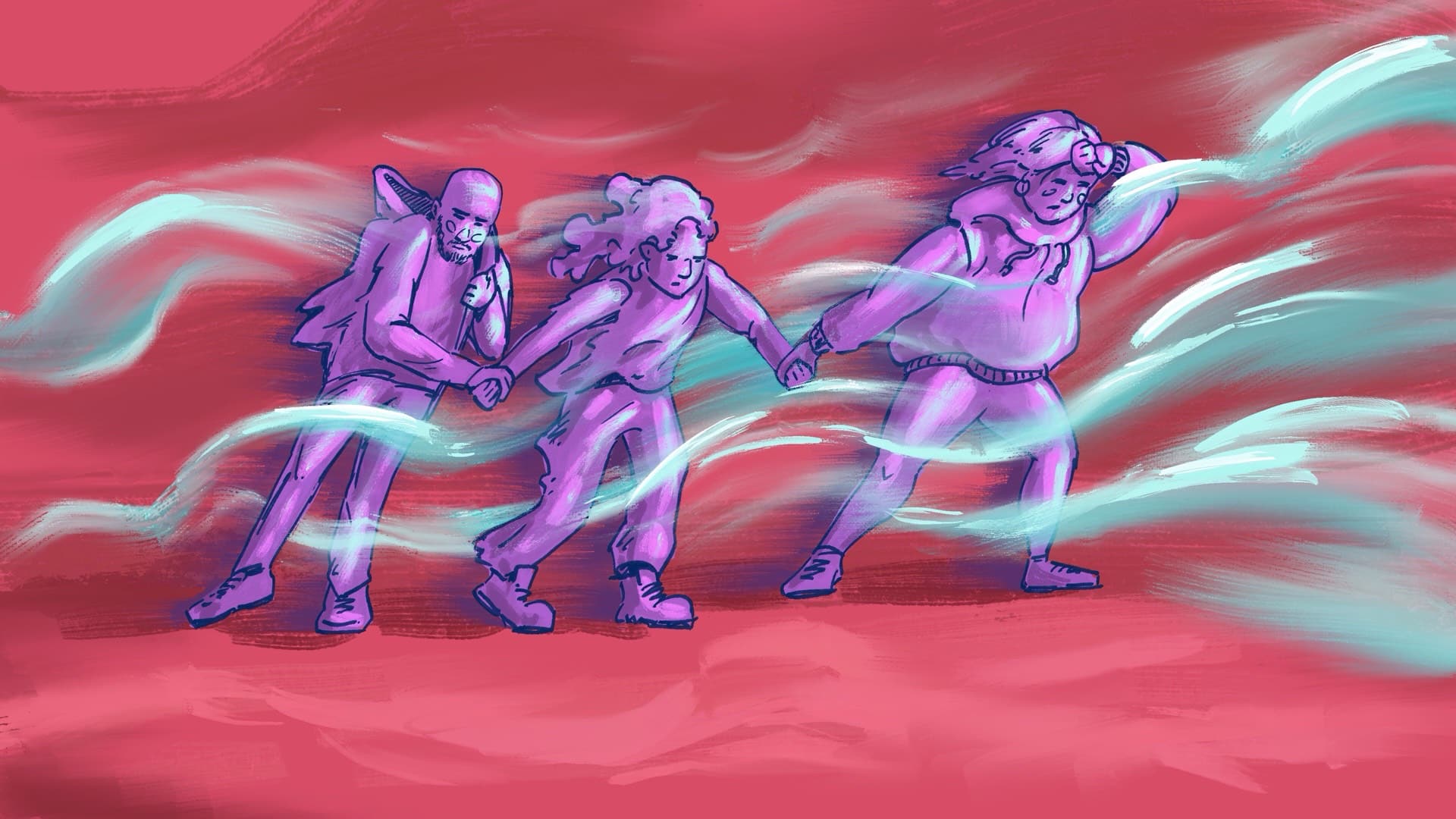

Materials to inform and share
Here you will find various materials on HIV, AIDS and queer health - digital or printed, to read, look at and pass on.
Sexual health and HIV/STI in trans...
„What needs exist in trans and non-binary communities with regard to sexuality and...
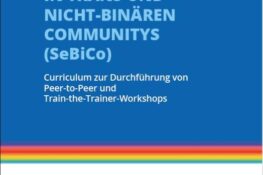
Sexual education in trans and non-binary...
This handbook presents the content developed as part of the SeBiCo project...
Help & counselling for sex workers
Here you will find support services relating to rights, safety, health, counselling and community services – nationwide and in Berlin.
Need someone to talk to?
Whether it's an urgent matter or just for guidance, sometimes it helps to talk to someone in confidence. Use the Gay Health Chat – the button at the bottom right will take you to the page. There you can get anonymous and free:
- Personal live advice in the chat
- Help by e-mail or telephone
- Information on health, law, everyday life and more
Advice centre for sex workers – Hydra e.V.
Counselling, legal support, health information & empowerment especially for sex workers.
To the websiteGerman AIDS Service Organisation – Information on sex work
Rights, safety, health and support for people in sex work.
To the websiteTrans*Sexworks Berlin
Community-based support for trans sex workers. Empowerment, counselling & resources.
To the websiteGerman Professional Association for Erotic and Sexual Services (BesD)
Counselling, legal information & political representation of sex workers' interests.
To the websiteLambda Berlin-Brandenburg
Support for queer young people, including on topics such as discrimination, violence and coming out.
To the websiteBerlin Crisis Service
24/7 psychosocial help for crises, violence, housing problems & stressful situations.
To the websiteWomen's and Trans* Safe Spaces Berlin
Emergency accommodation, shelters and counselling for FLINTA individuals threatened by violence.
To the websiteQueer Refugees Germany
Support for queer migrants – also relevant for undocumented sex workers.
To the websiteAmnesty International – Sex workers' rights
Materials, protection concepts & political work for decriminalisation and rights.
To the website