Chemsex & seduction: the thrill of intoxication
The other day in chat, an attractive young man sent me a picture of himself: sitting casually at a table covered with white and other powders, he grins at the camera. A glass pipe and other paraphernalia. He invites me to his place. I say that I don't take drugs, but I still toy with the idea of going to see him because I'm horny, or rather, restless.
I think about all the nights and days, the weekends that lasted until Wednesday, when I was high myself. I've been clean for eight years. Why did I take drugs? The simple answer: because I'm addicted. The more complex answer has something to do with the fact that I gayGay refers to men who are romantically and/or sexually attracted to men. Important facts about the term: - "Gay" is the term used to... Mehr I believe that drugs are part of gay history, that making contact with other men is – apparently – easier when a “social lubricant” is available.
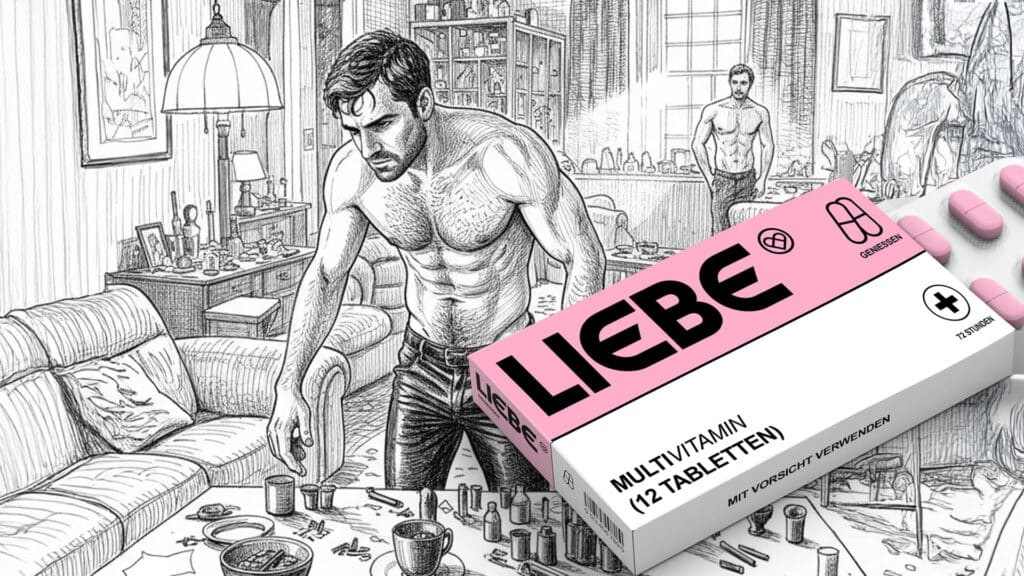
Chemsex as a phenomenon: substances, terms, motives
When I was still using drugs, we called it PnP (“party and play”), and even today, especially in chat rooms, h&h (“high and horny”) is still used. Drug use seems to be as normalised as a glass of wine with dinner, at least in some parts of the scene. But is this phenomenon really something new? After all, “sex and drugs” was already the motto in the 1970s, when gay club culture was in its infancy. But how does chemsex differ from substance use when partying in a club?
Chemsex refers to the consumption of substances (“chems”) such as GHB/GBL, KetamineKetamine is a drug that was originally developed as an anaesthetic in medicine. It has an analgesic, calming and sedative effect. Mehr, mephedrone, crystal meth and monkey dust before or during sexual intercourse. The term is mainly used in gay contexts or for MSMMSM is the abbreviation for "Men who have Sex with Men" - i.e. men who have sex with men. - The term describes behaviour, not ... Mehr (men who have sex with men). The substances are usually taken orally, nasally or by inhalation. Intravenous use is also observed, particularly with crystal meth.
The motives for chemsex are manifold: a desire to break down barriers, increase sexual performance or have a more intense sexual experience. The aim is to break down shame and taboos, create (apparent) closeness, intimacy or relationships, or deal with stress and insecurities about one's own body. The phenomenon is thus also understood as an individual and collective psychological defence mechanism to escape social and subcultural expectations.
Between self-optimisation and ecstasy
In his lecture “Intoxication and Sexuality” at Chemkon Berlin in March 2025, psychotherapist and philologist Dr. Dr. Stefan Nagel spoke about the relevance of ecstatic states: the higher the degree of self-control and external control, the stronger the desire to lose control.
As gay men, we are under a lot of external pressure, which we often internalise. In order to be accepted by society as a whole, we have to be “real men”, “normal” and strong, keep our emotions under control, and be productive and successful. In order to be accepted by other gay men, we have to be young and good-looking, work out, be sexually potent and promiscuous.
These demands lead to “minority stress” – we do everything we can to be perfect: we work longer hours, go to the gym more often, take Viagra so we can have sex for longer. It seems logical that with so much self-control, the desire to lose control arises. And that we resort to all kinds of aids to achieve this. KindThe abbreviation ART stands for antiretroviral therapy. - It refers to the treatment of an HIV infection with special medication that prevents the... Mehr also have an impact – especially when they are easily accessible and widely accepted. Both sex and drugs are “physically experiential, i.e. real remedies for what causes suffering,” according to Stefan Nagel in his lecture.
Chemsex & intimacy: closeness, bodies, desires
Chemsex is not only an escape from something, but also a search for intimacy that we may otherwise lack. An intimacy that is intensified by drugs. Perhaps the boy in the chat room the other day also “just” wanted to be held and loved. Instead, all that came out of his mouth (or keyboard) was: “Cum on me.”
What heterosexuals see as the continuation of our species was, until recently, a death sentence for us gays. Since HIV can be kept in check with medication, barebacking went through a phase of fetishisation and is now the rule rather than the exception. Which is completely natural – I want to be as close as possible to the object of my desire (or love).
And this is precisely where the chemicals come in: they simulate a fusion, a complete dissolution of boundaries between two (or more) men. A quasi-absolute intimacy with someone I usually don't even know, but to whom I open myself completely under the influence of the perfect cocktail of drugs.
But does intimacy really mean merging? Or is it rather not knowing where I end and the other person begins? Being generous with my own mistakes and those of others? Showing myself to be vulnerable, sometimes even unattractive, and allowing for moments of failure? Intimacy would be when you laugh anyway, when you love me anyway, when you stay anyway.
The chemsex community: between safe space and abyss
The German Chemsex Survey – a large-scale survey of 2,024 people – revealed that MSMMSM is the abbreviation for "Men who have Sex with Men" - i.e. men who have sex with men. - The term describes behaviour, not ... Mehr are often affected by minority stress, and chemsex users are often mentally distressed. However, it was noticeable that men who engage in chemsex are less affected by internalised homonegativity than men who use other substances (such as alcohol or poppers) during sex or consume drugs without sex.
“Internalised homonegativity” refers to the internalisation of social prejudices – whereby queer people experience themselves as different, inferior or even defective. At first glance, it is surprising that chemsex users in particular reported less internalised homonegativity, as one would assume that chemsex is a coping strategy for dealing with negative feelings.
As a man who has been involved in the chemsex scene myself, I am not entirely surprised by this result. Especially when “slamming” (i.e. intravenous consumption) crystal meth, I experienced an immense sense of belonging to a very specific group: gayGay refers to men who are romantically and/or sexually attracted to men. Important facts about the term: - "Gay" is the term used to... Mehr, HIV-positive, junkie, slammer. Or, as Prof. Dr. Daniel Deimel, one of the authors of the Chemsex Survey, puts it somewhat more positively: “The chemsex community as a safe space?”
Chemsex as a KindThe abbreviation ART stands for antiretroviral therapy. - It refers to the treatment of an HIV infection with special medication that prevents the... Mehr Communion among outsiders, then, pushed so far to the margins of society that we experience a sense of belonging when we find other men on those margins who are into the same things we are. And crystal meth in particular leads to a feeling of superiority. We feel unique because we are unique. We find pride in our brokenness.
When chemsex becomes a trap: from intoxication to problem
“Without taking anything at a chill? I couldn't do that.” Another attractive man, before we start kissing. Once again, I've ended up at a “chill”, one of those private drugs-and-sex events that are so easy to find in chat rooms. Even in my abstinence, I'm still attracted to the community outside of society.
Precisely because chemsex users experience this sense of community, it is difficult for men who perceive their consumption as problematic to find their way out of this context. This is compounded by the fact that it is already difficult to recognise that there is a problem when you are surrounded only by other consumers. In fact, similar to “sero-sorting”, i.e. only having sex with men with the same HIV status, “chems-sorting” takes place in the scene.
It is often a big step from recognising that there might be a problem to actually seeking help. Personally, I had to crash at home countless times after days of bingeing, alone and without my close-knit community, before I realised that I wasn't finding what I was looking for in chemsex. The search had become an addiction.
Ways out of chemsex: help, groups & new intimacy
For MSMMSM is the abbreviation for "Men who have Sex with Men" - i.e. men who have sex with men. - The term describes behaviour, not ... Mehr, There are various services available for those who engage in chemsex, depending on their needs. Those who want to reduce the risks associated with their consumption can have their drugs tested – in Berlin, for example, at three different locations, including the Gay Counselling Centre. Drug-Checking Berlin also issues current warnings about certain substances on its website. Various websites, including Deutsche Aids-Hilfe, provide information on “safer use”, i.e. measures to minimise the risks associated with consumption.
If substance use becomes problematic, the Drug Emergency Service in Berlin offers support. The website of the German Centre for Addiction Issues provides a directory of addiction support services for all federal states. Gay men seeking advice can easily contact the Gay Counselling Service, Checkpoint Berlin or AIDS-Hilfe. Checkpoint's “Chemsex Check” offers guidance on whether there might be a problem. Aids-Hilfe organises discussion groups in various cities, including Mann-O-Meter in Berlin. Schwulenberatung Berlin has a weekly open queer addiction group. Here, experiences are shared in a relaxed and non-judgmental environment.
And for those of us for whom chemsex has actually become a problem, there is the option of detoxification as well as outpatient and inpatient rehabilitation at medical clinics or specialised institutions. The only clinics with programmes for chemsex users to date are the Salus Clinic in Cologne-Hürth and Haus Lenné in Berlin.
Those who decide to pursue a path of abstinence in the long term will find like-minded people in 12-step groups such as Crystal Meth Anonymous or Narcotics Anonymous. There, experiences of abstinence – referred to as “recovery” in the groups – are shared and a sense of community is fostered, often leading to close friendships. The focus is not only on how we can (re)discover a fulfilling sexuality while remaining sober, but also on how we can build lasting intimacy and thus a fulfilling life.
FAQs about chemsex – definition, experiences and therapy
Chemsex raises many questions: What exactly is chemsex, what is a clear definition of chemsex, what kind of chemsex therapy is available, and how do others deal with their chemsex experiences? I have summarised the most important points for you here.
Chemsex refers to sex under the influence of certain drugs, such as crystal meth, GHB/GBL, mephedrone or KetamineKetamine is a drug that was originally developed as an anaesthetic in medicine. It has an analgesic, calming and sedative effect. Mehr. These substances are consumed specifically to enhance pleasure, stamina, disinhibition or intimacy. The term is mostly used in gay contexts or in relation to MSMMSM is the abbreviation for "Men who have Sex with Men" - i.e. men who have sex with men. - The term describes behaviour, not ... Mehr (men who have sex with men).
A commonly used definition of chemsex is:
Chemsex is the planned use of psychoactive substances in connection with sexual encounters in order to achieve certain physical or emotional effects – such as increased pleasure, reduced shame or a more intense sense of community.
Many report feelings such as the following in their chemsex experiences:
– fewer inhibitions and less shame
– Increased sexual performance
– intense closeness or „merging“ with others
At the same time, some also describe very stressful chemsex experiences: loss of control, crashes after days-long sessions, loneliness afterwards, or difficulties experiencing sexuality without drugs.
Chemsex therapy is not a single method, but rather a range of support services, for example:
– consultation meetings at queer counselling centres or AIDS support organisations
– addiction counselling and outpatient therapy if consumption gets out of control
– Inpatient programmes (Rehabilitation, detoxification) in clinics specialising in chemsex
– self-help groups such as Crystal Meth Anonymous or Narcotics Anonymous
The aim of chemsex therapy can be to reduce consumption, make it safer or quit altogether – while at the same time developing a sexuality that is harmonious even without drugs.
If you feel that your chemsex experience is bothering you, you can contact queer counselling centres, AIDS support organisations, specialised addiction counselling services or online chats (see below). There, you can talk about your situation confidentially and anonymously and work out together whether and what form of support (e.g. chemsex therapy or self-help group) might be right for you.
More blog posts that may interest you
Discover more stories and background information on sexuality, intoxication, mental health and community – with personal experiences, information and support.


Materials to inform and share
Here you will find various materials on HIV, AIDS and queer health - digital or printed, to read, look at and pass on.
HIV / AIDS, hepatitis and sexually transmitted diseases
Basic information on transmission, protection, diagnosis, treatment | 2023 „HIV/AIDS, hepatitis and sexually transmitted diseases“...

Help and advice on chemsex
Here you will find contact points for drug checking, safer use, counselling and self-help groups.
Need someone to talk to?
Whether it's an urgent matter or just for guidance, sometimes it helps to talk to someone in confidence. Use the Gay Health Chat – the button at the bottom right will take you to the page. There you can get anonymous and free:
- Personal live advice in the chat
- Help by e-mail or telephone
- Information on health, law, everyday life and more
Drug checking in Berlin
Information and locations for testing substances in Berlin.
To the websiteSafer Use – German AIDS Service Organisation
Tips for safer drug use.
To the websiteBerlin Drug Emergency Service
Emergency help and counselling for drug problems.
To the websiteAddiction support directory (DHS)
Nationwide directory of addiction support services.
To the websiteGay counselling Berlin
Advice for queer people on alcohol, drugs and chemsex.
To the websiteChemsex Check – Checkpoint Berlin
Self-test to assess your own chemsex consumption.
To the websiteDrugs & substance use – AIDS support
General information about drugs, risks and support.
To the websiteChemsex support – QuApSSS
Support services for people with chemsex experiences.
To the websiteChex – Man-O-Meter Berlin
Counselling and group services specifically for chemsex.
To the websiteSalus Clinic Hürth
Stationary programme for MSMMSM is the abbreviation for "Men who have Sex with Men" - i.e. men who have sex with men. - The term describes behaviour, not ... Mehr with chemsex consumption.
To the websiteLenné House Berlin
Therapy and rehabilitation services also available for chemsex users.
To the websiteCrystal Meth Anonymous
12-step self-help group for people with crystal meth problems.
To the websiteNarcotics Anonymous
Self-help group for people with drug addiction.
To the website