

Key points at a glance
⚠️ A wide variety of symptoms
HIV symptoms vary greatly from person to person. They are non-specific and can also occur with other illnesses.
🤒 Flu-like symptoms at the onset
Shortly after infection, symptoms similar to those of flu may occur, such as a fever, fatigue, night sweats or swollen lymph nodes. These usually disappear on their own after a short time.
⚠️ Damage despite the absence of symptoms
The initial symptoms are usually followed by a long period without any symptoms. However, HIV continues to damage the body during this time.
💊 Treatment prevents AIDS
With HIV medication, it is possible to live a long and healthy life. It can prevent the onset of AIDS.
The progression and symptoms of HIV
The course of an HIV infection can vary greatly and the symptoms are not always clear. Many people do not even realise that they are infected with HIV in the initial phase. Others experience flu-like symptoms or skin reactions that they do not initially associate with HIV.
In men in particular, typical HIV symptoms such as fever, night sweats or a rash often present as non-specific and are easily overlooked. This makes it all the more important to understand the progression of HIV: from infection and the incubation period, through the first signs, to the possible development of AIDS if left untreated.
With modern HIV therapy, the progression can be stopped. Those who act early stay healthy and do not pass on the virus.
In the following sections you will find detailed information on:
- the first symptoms and the HIV incubation period,
- the question of how an HIV infection manifests itself,
- the course without and with treatment,
- the symptoms of AIDS.

HIV incubation period and the body’s initial symptoms
Shortly after becoming infected with HIV, the so-called HIV incubation period begins. This is the phase between transmission and the first signs of illness. It usually lasts between two and four weeks. During this time, the virus multiplies particularly rapidly in the body. As the graph shows, the viral load in the blood rises rapidly and peaks around the third week.

During this phase – the acute phase of HIV infection – the first symptoms may appear. These are usually non-specific and are easily mistaken for a cold or flu. The symptoms can vary greatly in nature and severity. It is particularly important to note that during this period, the viral load in the body is very high, and so is the risk of passing HIV on to others.
Typical symptoms in the early phase of an HIV infection are
- Fever
- Fatigue and tiredness
- Night sweats
- Diarrhoea
- Swollen lymph nodes (especially in the neck)
- Muscle pain
- Sore throat or tonsillitis
- Skin rash, mostly reddish and on the upper body
These symptoms usually last for 7 to 10 days and disappear on their own. During this acute phase, the viral load in certain bodily fluids is particularly high - especially:
- in the blood
- in semen
- in mucosal secretions
This makes HIV particularly easy to transmit during this time Even if the immune system already reacts to the infection during the HIV incubation period, antibodies can only be reliably detected in the blood after around six weeks - for example with an HIV laboratory test. During this time, the virus already begins to damage parts of the immune system - especially the so-called helper cells.
The clinical course without treatment
Without treatment, HIV infection progresses in several stages.
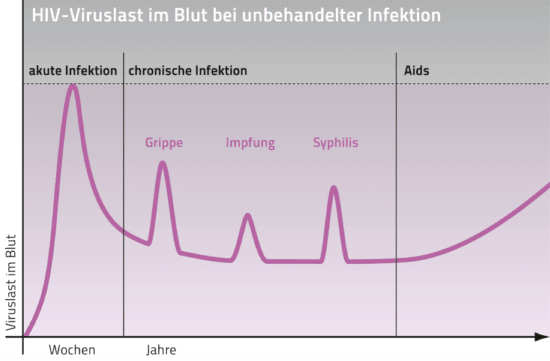
The graph shows how the viral load in the blood changes over time: from the sudden rise in the acute phase to the transition to the AIDS stage. This process can take many years.
Acute phase: rapid viral replication
Shortly after infection, the viral load in the blood rises sharply, as shown by the steep rise on the far left of the graph. During this acute phase of infection, many people experience flu-like symptoms. The concentration of the virus in the blood, semen and other bodily fluids is particularly high at this stage, as is the risk of transmission.
Chronic infection: latent phase with no symptoms
After a few weeks, the viral load drops significantly and the infection enters the latent phase, shown in the middle section of the graph. This phase can last for several years. Although HIV remains active, it replicates at a much slower rate. Most people do not experience any symptoms during this time, yet the immune system continues to be gradually weakened. Additional infections or reactions to vaccinations, such as those caused by flu or syphilis, are shown in the graph as slight fluctuations in the viral load.
AIDS: severe immunodeficiency
Without treatment, the infection continues to progress, as can be seen from the rising viral load in the right-hand half of the graph. At this stage, the condition progresses to the AIDS stage: the immune system is then so severely damaged that it can no longer defend itself against so-called opportunistic infections or certain types of cancer.Z
The course with modern HIV therapy
Thanks to modern medicines, the course of an HIV infection has changed fundamentally. Antiretroviral therapy, or ART for short, suppresses the virus’s replication so effectively that it is often no longer detectable in the blood. This not only protects one’s own health, but also prevents transmission during sex – known as the U=U principle: Undetectable = Untransmittable.
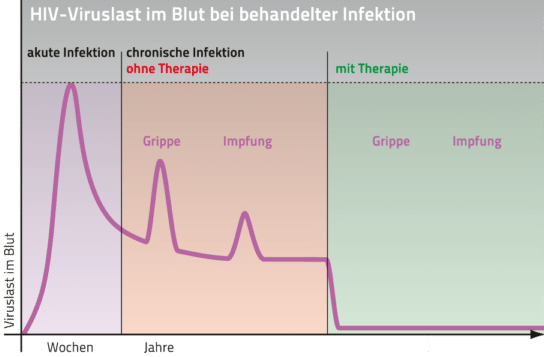
The graph above clearly shows the difference:
After the acute phase of infection (left-hand side) the viral load decreases under therapy (green area) remains at a very low level over the long term, usually below the detection limit. This means that the immune system remains stable and the person affected can lead a healthy life.
Without therapy (medium range) the viral load remains significantly higher. Factors such as the flu, reactions to vaccinations or other illnesses can cause it to rise again and again. It is only once treatment with HIV medication begins that the viral load drops significantly and subsequently remains stable in the long term, even if, for example, the flu or a vaccination occurs in the meantime.
Important: The medication must be taken daily and continuously. Regular medical check-ups ensure that the treatment remains successful and the viral load is low.
Conclusion: Early detection of HIV
HIV is now easily treatable. The key is to detect the infection in good time. Anyone who gets tested regularly and starts treatment early can lead a long, healthy life with HIV, without any restrictions in their daily life or sex life.
Modern treatment not only protects the immune system, but also reduces the viral load in the blood to such an extent that HIV is no longer transmissible (U=U: undetectable equals untransmittable). This increases your own safety and protects others.

The graph shows how the amount of virus and antibody formation develop after an HIV infection:
- The viral load rises sharply immediately after infection.
- A few weeks later, the body begins to produce antibodies against the virus.
- An HIV laboratory test can usually reliably detect these antibodies from week 6.
- The so-called diagnostic window for rapid tests is 12 weeks.
At this time in particular, many people feel healthy or experience non-specific symptoms such as a fever, tiredness or a rash, which they do not take seriously. Typical early signs of an HIV infection can therefore easily be overlooked or misinterpreted.
Take any possible symptoms seriously and get an HIV test so that you can find out for sure quickly and take the appropriate action.
Frequently asked questions
How can you reliably recognise an HIV infection?
An HIV infection can only be clearly determined by a test. Initial signs are often unspecific and are not sufficient for a reliable assessment. A laboratory test provides a reliable result from six weeks after a risk contact.
What symptoms can occur with an acute HIV infection?
Typical symptoms in the early stages can include fever, night sweats, fatigue, swollen lymph nodes, sore throat, diarrhoea or a rash on the upper body. These symptoms usually disappear after a few days.
How long does it take for symptoms to appear after infection?
The first symptoms usually appear two to four weeks after infection. This period is known as the acute phase. It is not the same for everyone affected.
What distinguishes HIV from AIDS?
HIV is the virus that causes a chronic infection. Aids is the advanced stage of the disease, which can occur years later without treatment. Aids can be prevented with today's therapy.
How often should I be tested for HIV?
If you have regular sex with changing partners, a test every three to six months is recommended.
Does HIV therapy also protect others?
Yes, anyone who is successfully treated and has a viral load below the detection limit can no longer transmit HIV during sex. This realisation is medically proven and is described as U=U (undetectable = not transmissible).