ANYTHING IS POSSIBLE Bi+ TO BE.
Open PDF
Bi+
What does Bi+?
Bi+ is an umbrella term for people, identities and life experiences in which feelings or attraction are directed towards people of more than one gender.
The plus sign makes it clear that this term encompasses many different ways of identifying oneself, such as bi+, pan or queer.
The Bi+ In Bi+ self-definitions, this is understood as an attraction to more than one gender. As early as the 1990 Bisexual Manifesto, there was opposition to binary notions of bisexuality and gender.
A well-known definition by Robyn Ochs
„I identify as bisexual because I recognise that I may potentially be attracted to people of more than one gender, whether sexually and/or romantically. Not necessarily at the same time, in the same way or with the same intensity.“
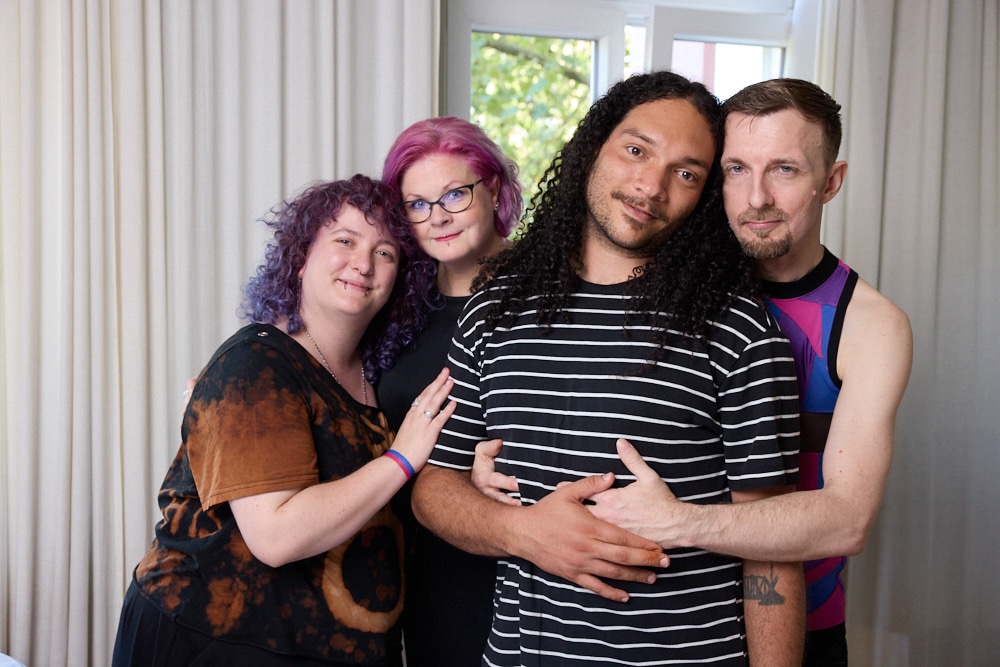
Feelings, behaviour and self-identification may align, but they do not necessarily have to. People may be attracted to different genders without having had corresponding experiences or using a ‘Bi+’ label.
Even a relationship interpreted as heterosexual or homosexual does not alter one’s identity. Romantic and sexual attraction can, furthermore, differ – for example, in the case of a panromantic and asexual person.
For further information: Carolin Reiß, Bi+ Unit at BiBerlin e.V.

HISTORY
Visibility & Self-organisation
Bi+ history has long been overlooked.
Bi+ people have helped shape queer, feminist and anti-racist movements from the very beginning. However, their contributions have often been categorised as gay or lesbian. This timeline highlights some of these Bi+ contributions.
Groups of their own are forming
In Germany, since the 1970s and 1980s, more and more independent bi+ groups have been springing up. This is creating new spaces for dialogue, self-help and visibility.
For further information: Carolin Reiß, Bi+ Unit at BiBerlin e.V.

Stories
Bi+ can take so many different forms
Personal experiences, thoughts and perspectives from Bi+ people. They talk about their journeys, identity, relationships, coming out and visibility, and how differently being Bi+ can be lived, understood and experienced.

My journey to identifying as bi+
Rolf talks about his first intimate experiences with a man, his journey into the bi+ community, and how important...
More about My Journey to Bi+
Proudly Bi+
Thilo talks about his journey as a bisexual man – from his first experiences and his early identification as bi+ to queer...
More about ‘Self-Confident Bi+’
Bi+ Prejudices and Stereotypes
Antonio talks about prejudice against bi+ people, bi erasure, coming out and visibility. The discussion centres on...
More on Bi+ prejudices and stereotypes
Frank's coming out as a bisexual man
Frank is bisexual, a teacher – and an activist. He has come out in his private life, amongst his colleagues and in front of a school class. Today, he….
More on Frank’s coming out as...
"Bisexuals question pigeonholes"
Hamburg is hosting its first Pride event for bi+ and sexual people this September. Frank Thies explains why the march is important...
More on „Bisexual people...’.
#MyMentalMe: How healthy is the bisexual male soul?
Don’t bisexual (bi+) men have it much easier? After all, they can hide away in a „straight relationship“ and...
More on #MyMentalMe: How healthy is...
Bisexual and polyamorous – A story about...
Bisexual and polyamorous – Jan lives with his girlfriend and boyfriend in a V-relationship. How does sex between men work without...
More on being bisexual and polyamorous...
COMMUNITY
COMMUNITY(S)
Belonging, visibility and bi+ spaces
Between Rooms
A sense of belonging is not always a given.
Bi+ people often move between different social and queer spaces without necessarily feeling that they belong there. Even in queer spaces, they may experience exclusion or feel that they do not queer enough to be. Because a bi+ identity is often not visible and people are categorised as monosexual, many go through repeated coming-out experiences and have to redefine their identity time and again.
Dedicated Bi+ spaces
Exchange, belonging and empowerment.
Creating dedicated Bi+ spaces fosters dialogue without the need to explain these experiences straight away. Meeting other Bi+ people can help you make sense of your own identity, feel a sense of belonging and combat isolation. They are therefore spaces for community, self-acceptance and empowerment.
Part of the queer communities
Not merely implied, but explicitly mentioned.
Bi+ people are also a natural part of queer communities. Explicitly addressing Bi+ people can open up new avenues, particularly for those who are not out, who are in relationships perceived as heterosexual, or who do not feel represented by general queer initiatives. Queer spaces become more inclusive when Bi+ people are not merely included by implication, but are explicitly addressed and their diverse life experiences are recognised.
For further information: Carolin Reiß, Bi+ Unit at BiBerlin e.V.

LANGUAGE
LANGUAGE IS MAKING
Words can restrict. Words can reveal.
Language influences what is socially accepted.
Language influences what is socially accepted. If ‘Bi+’ is not explicitly mentioned, sexual and romantic identities are narrowed in a monosexist way. Terms such as Bi+ erasure and Bi-phobia make structural discrimination identifiable, and self-identifiers can help to shape identity. The umbrella term Bi+ It counteracts narrow views of sexuality and raises awareness of romantic identities and diverse self-identifications, which is particularly relevant given the hypersexualisation and fetishisation of bi+ people.
Inclusive language broadens horizons rather than restricting them.
Bi+ and queer-inclusive language avoids binary phrasing such as the two sexes and talks, for example, about People of different genders. Also can’t make up their mind or go to the next page reproduce monosexual notions. It is crucial to take people’s self-identifications seriously and not to impose identities from the outside.
For further information: Carolin Reiß, Bi+ Unit at BiBerlin e.V.

HEALTH
PREVENTION & HEALTH
Good care takes a holistic approach to physical and mental wellbeing, safety and self-determination.
Bi+ sensitive prevention and care must take a holistic approach to sexual and mental health, as well as protection against discrimination. Stress is not caused by Bi+ identity, but by Bi+phobia, minority stress, a lack of recognition and violence. Prevention should reduce risks and enable self-determined, pleasurable and informed sexuality.
MENTAL HEALTH & CARE
Recognition is part of good care.
Studies show that Bi+ people experience higher levels of psychological distress than heterosexual, gay and lesbian* people. Internalised bi+phobia – that is, the incorporation of societal devaluation into one’s own self-image – can exacerbate these pressures. When bi+ identities are called into question within the healthcare system, this can undermine trust and access to support. Bi+ affirmative services must therefore recognise these specific experiences.
SEXUAL HEALTH & GAPS IN CARE
Prevention is based on practices, not on labels.
Bi+ HIV and STI prevention focuses on specific practices and protection needs rather than on presumed identities. The term MSM (men who have sex with men) describes behaviour, but does not replace explicitly addressing Bi+ men and masculine-presenting people. At the same time, Bi+ women and genderqueer people are less likely to find low-threshold and cost-reduced testing services.
Prevention covers areas such as HIV/STIs, safer sex, PrEP and PEP, as well as substance use and safer use. It should take different lifestyles into account without judging specific practices or portraying bi+ people as being particularly willing to take risks.
INFORMATION & ADVICE
Services must be sensitive not only to queer people, but also to bi+ people.
Across Germany, organisations such as AIDS charities and public health authorities offer counselling and testing. In Berlin, for example, there are Checkpoint BLN, Berliner Aids-Hilfe and Safer Sex Berlin. The Bi+ Centre (BiBerlin e.V.), which is funded by the State of Berlin, provides psychosocial support to Bi+ people and their families and is the only state-funded Bi+ support centre in the country. This also highlights a gap in provision, as not every service aimed at the queer community is necessarily Bi+ sensitive.
ALLIES & ALLIANCE
Responsibility must not rest solely with Bi+ people.
Allyship means taking people’s self-identification seriously, challenging statements that are hostile towards bi+ people, and not outing people. The responsibility for this must not rest solely with bi+ people.
Bi+ perspectives should be explicitly mentioned in texts, events, committees, campaigns and awareness-raising initiatives. Gay is not an umbrella term for all queer people. Invitations can make it clear that Bi+ people and their partners of all genders are welcome. This includes actively incorporating Bi+ perspectives and supporting Bi+ spaces. Intersectionality is key: overlaps with issues such as racism, hostility towards TIN people or ableism create additional barriers.
For further information: Carolin Reiß, Bi+ Unit at BiBerlin e.V.
FIGURES
What studies show – and what often remains unseen.
Attraction within the bi+ spectrum
Around 20 % of the total population in Germany report being attracted to people on the bi+ spectrum.
Figures & information: Carolin Reiß, Bi+ Unit at BiBerlin e.V.
INVISIBLE?
If you’re bi+ invisible is done
The realities of bi+ life are often overlooked, denied or attributed to other groups.
Bi+ Erasure
This erasure is known as Bi+ erasure. Kenji Yoshino describes this as a structural phenomenon. It manifests itself when Bi+ perspectives are absent from the media, research or historical narratives.
Bi+ hostility
Bi+ erasure is a form of Bi+ hostility. This includes discriminatory attitudes and structures, as well as devaluation, exclusion, sexualisation, fetishisation and violence.
Stereotypical images
Bi+ women and people who are perceived as female are frequently hypersexualised and fetishised. Bi+ men are particularly often denied their identity; they are regarded, for example, as closet gay, undecided or health risk.
Monosexism
Bi+ realities challenge the prevailing monosexism: the socially constructed norm that people are only attracted to one gender.
Bi+ erasure is (un)consciously perpetuated in the heteronormative mainstream society as well as within queer communities. It is also evident when people are categorised as monosexual on the basis of their romantic partners.
For further information: Carolin Reiß, Bi+ Unit at BiBerlin e.V.
STEREOTYPES
Cliché on the one hand.
Fact on the other hand.
There are many misconceptions circulating about Bi+ that have little to do with the realities of life. Turn the cards over.
FAQ
Common Questions
In a nutshell: frequently asked questions about bi+ identities, labels and attraction.
No. Common terms used to describe oneself are Bi+ (attraction to more than one gender), pan (regardless of gender), omni (all genders), ply/poly (several, not all) or queer (outside the hetero/cis-gender norm) or no label.
No. Attraction to different genders can vary in intensity, feel different and change over the course of a person’s life.
Yes. Neither past experiences nor a current relationship define one’s identity. Bi+ people can also be in long-term monogamous relationships.
Yes. Trans and non-binary people can be bi+ themselves and be desired by bi+ people (see definition).

Bi+ to take away
A concise summary of the key information on Bi+, visibility, the community and health. You can download the BICONIC PDF free of charge.
Open PDF