How the gay leather scene began
There was no such thing as a leather scene when Manfred Stavenhage discovered his leather fetish. In 1960, at the age of 16, he found himself in the shop of a Munich leather outfitter who "immediately" recognised a leather fetishist in him and put him in touch with others. Manfred bought his first leather jacket there and deposited it in the shop to hide it from his Jehovah's Witness family. With his new gay acquaintances at the time, he regularly visited the Ochsengarten pub after the strict closing time, where the landlady Auguste Wirsing let her guests in through the back door. "She really wanted to make a gay pub because her best sexual experience was with a gay man," Manfred remembers. Mrs Wirsing was persuaded to turn the Ochsengarten into a leather bar using second-hand boots as decoration - one of the most successful: later popular with Freddy Mercury and Barbara Valentin.
First experiences with leather fetishism and the gay community
The legendary Munich leather bar Ochsengarten also played a role in the gay development of Olaf Hatmannsgruber and Thomas von Stein: after impressive TV experiences with the gay film classic "Cruising" (1980) and the Village People's Lederkerl, Olaf made his first contacts with the gay leather scene here in 1984. After a period of rather distanced observation, he dared to have his first "leather sex": "You try it and from then on you can start. I pluck up all my courage, stand on the three-metre board, so to speak, and now I jump!"
Thomas, too, recalls having been fascinated by leather even as a child: he was captivated by Bavarian men in biker gear and pirates. So when he first got into the leather scene in the 90s, he had a clear agenda: He wanted to meet exactly those „macho“ men, rather than the „typical gay bloke“ with a blow-dried quiff and a pink polo shirt, who, according to the dress code, wouldn’t have been allowed into the Ochsengarten fetish bar anyway. Men dancing *Swan Lake* as the four swans. That looked brilliant.
Leather clubs, shows and gay culture
Nevertheless, the leather scene was already very kinky back then. Manfred, who incidentally was part of the first German leather meeting, founded and ran the Munich fetish club "Löwenclub", the leather bar "Zum Lohengrin", which was named after his nickname for a long time, and was also a prop master at the Munich State Opera. According to his recollection, almost all the leathermen of the 1970s came from the theatre. The meetings of the leather clubs were often crowned by elaborate shows, of which he reports: "Swan Lake with the four swans danced by gentlemen. That looked awesome."
Berlin’s leather scene: masculinity, protection and visibility
Nevertheless, it cannot be denied that the predominant image of masculinity in the leather scene was and still is a martial one - especially in contrast to the rather loud and tuneful gay movement. Not only sexual preferences played a role in this, but also a certain protection from direct homophobic confrontations: The "charade" of masculinity, which Olaf elaborates on as the two-pronged nature of the leather scene, served to be recognisable as a gay man in leather on the one hand - and to come across as a tough rocker or biker to most people in the heterosexual mainstream on the other. The leather clubs were also rather hidden, as a glance at the names reveals. The "Löwen" in the Munich Löwenclub refers to "leather", while the US association "Cycle MC" more or less pretended to be a motorbike club. This was to pull the wool over people's eyes, as Manfred puts it.
Between freedom, the AIDS crisis and loss
The USA, and San Francisco in particular, were sometimes much freer in their approach to the fetish popular among gay men. From 1987, Olaf experienced a completely different freedom there: gay leather guys in public were part of everyday life and offered a community in which he could develop - although the late 1980s heralded an extremely difficult phase in the leather scene in particular.
Over the course of the decade – and particularly dramatically from 1986 onwards, as Manfred recalls – AIDS shook the leather scene to its core. As early as the mid-1980s, Manfred hired a cinema in Munich so that, with the help of film legend Manfred Salzgeber, he could screen an educational film on the subject free of charge: „Some people were up in arms, asking how anyone could show such rubbish. They simply didn’t recognise the danger back then.“ In 1987, he lost his partner at the time to AIDS – by no means the only loss in his circle. He stopped counting at 200 when he once tried to put a figure on the number of acquaintances and friends who had died. „My generation – almost all of them have passed away. AIDS simply caused a great deal of destruction.“ Including the leather scene’s infrastructure.
AIDS, safer sex and solidarity in the leather scene
„There are perhaps only two leather bars left in Berlin these days,“ notes Manfred, who, like Olaf and Thomas, now lives in the capital. Although he also admits that the internet has played a part in this.
Thomas von Stein used to be a regular guest at his friends„ funerals, too. AIDS dominated the gay scene in the 80s and 90s, and the special sense of “camaraderie„ within the leather community provided a feeling of protection against the uncertainty and grief, Thomas recalls – even though he now takes a critical view of the term “camaraderie’. His first relationship eventually broke down over the issue of safer sex. This was a major point of contention amongst gay men at the time. During the AIDS era, leather men in particular came to be seen by many as the epitome of hardcore sex orgies – and thus as a personification of danger.
This is a misconception, as Thomas recalls that the ritualised practices within the leather scene were, in fact, often already a form of safer sex. In any case, the leather scene provides an open space in which to explore sexuality outside the mainstream. Thomas explains that leather has allowed him to have a wide range of sexual experiences, such as learning to take on the role of a dominant partner.
Why leather is so fascinating to gay men
But what is it about the material in general? Thomas, Olaf and Manfred all talk about early memories of their fascination: acoustics, smell - and the feeling of a second skin. In addition, black leather emphasises a masculine impression. "Fancy shuffling" is not possible in a leather uniform, states Thomas. The black leather worn - with all its sensory properties - therefore lends the wearer a masculinity that, as all three also emphasise, is exaggerated to the point of hyper-masculinity.

Leather, age and gay beauty ideals
The leather outfit is therefore a travesty of masculinity, which can in fact create effective illusions. It is not the individual components that matter, but rather how they are worn as a whole by the „leather man“, who becomes such through them. The leather fetish, amongst other things, „partly pushes the “youth fetish„ into the background“, as Martin Dannecker writes in *Sexuality and Society*. Nevertheless, even here, a younger man who possesses a body that conforms to prevailing ideals of beauty and is also a leather fetishist becomes ‘an idol of desire’ within the scene. This means that the cult of gay youth is not entirely undermined after all.
In the past, Manfred has even had the experience of being refused entry to Berlin’s leather bars because of his age: „This has always been my life – why should I suddenly say I’m staying at home? They’ll just have to put up with seeing older people too. It’s not as if they have to have sex with me.“ Nevertheless, Thomas and Olaf are convinced that, particularly in the leather scene, you can still „make a success of things“ even in old age: „I think it’s very pleasant to grow old as a leather man,“ explains Olaf. Thomas feels that leather outfits emphasise masculinity and also draw attention away from a bit of a paunch. The cult of beauty seems to be undermined to some extent, yet, as he points out at the same time, the ideal of the aforementioned rock-hard masculinity still prevails among many leather-loving gay men.
Criticism of hypermasculinity in the leather scene
In the 1970s, some political pundits accused leather men of being close to fascism because of this cult of masculinity - and protested knitting in front of the darkroom in the West Berlin leather bar Knolle. In contrast, Thomas also sees this leather masculinity as a way of dealing with gay gender roles: "The insecurities and doubts about your own masculinity that you experience as a gay man - that's gone with leather." Even if the accusations of the faggots in the 70s were perhaps too simplistic, Manfred, Thomas and Olaf think a certain critical distance is definitely appropriate: leather masculinity is cool because it appears so disproportionately, but this ideal can also become a problem if it is taken seriously. "Perversity is the salt in the soup and you have to be careful not to over-salt your soup," says Manfred. However, this problem mainly concerns rigid images of masculinity, rather than perversions or the attractiveness of masculinity in leather travesties.
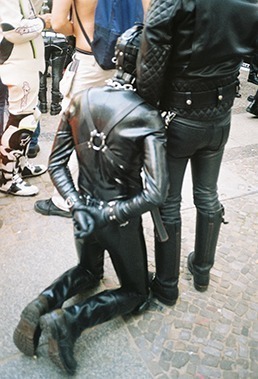
Berlin’s leather scene: community, events and change
However, alongside all the questions about images of masculinity and gear, the aspect of community within the leather scene should not be underestimated. Thomas, Olaf and Manfred all talk primarily about their contacts and trips to the USA. The international and nationwide leather scene has shaped their lives for decades. Olaf fondly recalls a huge Mister Leather contest in Chicago. What impresses him most, apart from the sex, are the colourful characters in the scene.
That’s why, on his website Male.Space, he also organises events that don’t just focus on „the sexual side of things“: for example, his leather dinner, where he aims to „provoke“ publicly with other leather men in a mainstream restaurant, whilst at the same time seeking greater acceptance. For Thomas, on the other hand, leather events have lost too much of their sexual edge in recent years: „It used to be about having sex there too, but now I often get the feeling it’s all about who has the latest model and the smartest uniform.“
Manfred also criticises this superficiality, although, like the others, he notes that gay men today are more interested in a variety of fetishes, whereas leather played a very dominant role as a gay fetish until the 1990s. This can be seen, for example, in the currently popular puppy fetish, which the three traditional leather guys tend to observe with a benevolent distance. Although Olaf organises "crossover" events, where women and people in casual outfits are sometimes allowed to attend, he also wants to see real leather outfits at a leather evening and not fashionable party harnesses.

Between Fetish and Identity
Accordingly, the leather scene too sometimes needs to draw boundaries as to what actually constitutes a leather fetish – and what does not. Given the many very active leather clubs that have existed since the 1970s, and in relation to the question of whether there is too much or too little sex in the scene, the central question here is whether the leather scene is centred around a sexual fetish or an identity. Of course, the answer lies in a tension-filled relationship between the two. This relationship underpins, not least, the early memories of a fascination with leather, which are almost identical to those of early gay desire.
And it is this tension between fetish and identity that has fuelled the emergence of leather groups and their scene, which, beyond a vague sexual charge, revel in what makes leather so special. Even though the cult of masculinity is becoming increasingly diluted – a trend that Thomas discusses and welcomes – the leather scene still needs the alluring stereotype of the „leather man“, which it has created itself and which continues to attract new admirers. Manfred, however, takes a relaxed view of the changes within the scene: “Life is always changing, and no one can say that only their way is the right one.”