

Key points at a glance
🛡️ Highly effective protection against HIV
When used correctly, PrEP provides very reliable protection against HIV infection.
💊 Can be taken flexibly
PrEP can be taken on a long-term basis or specifically to cover periods of potential HIV risk.
🧪 Regular checks
HIV tests, kidney checks and tests for other sexually transmitted infections are all part of PrEP.
👩⚕️ Under medical supervision
PrEP is prescribed by trained doctors and is subject to medical supervision.
What is HIV PrEP?
HIV PrEP is a method of protection against HIV. It involves taking an HIV medication before, during and after situations where there is a risk of HIV exposure. When used correctly, PrEP offers the same level of protection as condoms or viral suppression.
You can take PrEP every day or when you are exposed to potential risks. It does not protect against other sexually transmitted infections.
How HIV PrEP works
PrEP uses active ingredients that are also used in HIV treatment. In Germany, these are tenofovir and emtricitabine. They are absorbed through the stomach and enter the body’s cells via the bloodstream.
When HIV enters the body, the active ingredients block the virus from multiplying. For the protection to be effective, there must be sufficient active ingredient present in the body.
That is why it is important to continue taking PrEP even after a possible exposure to HIV. If you stop taking it, the level of the active ingredient in your body decreases. This means that the protective effect also wears off.
In extremely rare cases, transmitted HIV may already be resistant to PrEP medication. In such cases, it is possible to contract HIV despite taking the medication correctly. To date, only a very small number of such cases have been reported worldwide.
Getting HIV PrEP
If you are covered by statutory health insurance and are at increased risk of HIV, your health insurance provider will cover the cost of PrEP medication and the necessary follow-up examinations. Private health insurance providers have their own rules.
The first step is a consultation with qualified doctors. During this consultation, they will determine whether PrEP is suitable for you and what tests are required.
If all the criteria are met, PrEP can be prescribed to you on a prescription covered by the health insurance scheme. The prescription is valid for three months. A new prescription can then be issued at each of your regular check-ups.
It is also possible to obtain a private prescription. In this case, you will have to pay for the medication and tests yourself.
There are PrEP clinics in every federal state. You can find suitable doctors via the search function on the Federal Ministry of Health’s website, as well as through the lists of services provided by dagnä or prep.jetzt, amongst other sources.
Taking HIV PrEP correctly
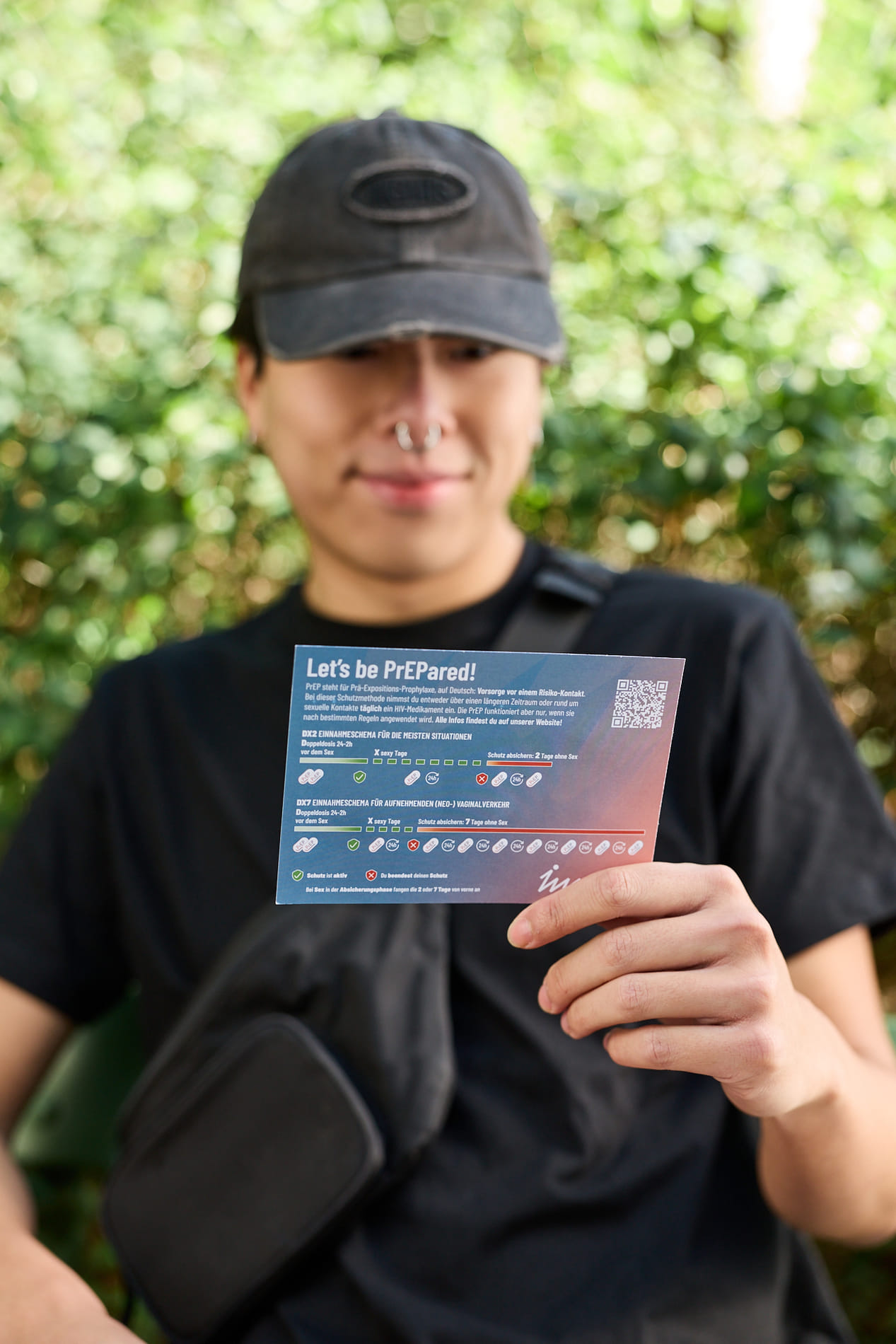
With HIV PrEP, you take one tablet a day. This can be taken over a longer period than Permanent PEP or specifically focusing on potential HIV risks as Short-course PrEP should be taken. Deutsche Aidshilfe recommends a standardised dosing regimen for this. It applies regardless of gender identity and sexual orientation.
- Starting PrEP: Take two tablets at once. The double dose should be taken no earlier than 24 hours and no later than 2 hours before the first possible exposure to HIV.
- Maintain protection: You should then take one tablet a day. There should be a gap of around 24 hours between doses. A deviation of up to 2 hours is permissible.
- Continuing to take PrEP after the last instance of HIV exposure: During anal sex (both penetration and reception), as well as during vaginal sex (penetration) or neovaginal sex, you should also One tablet a day for 2 days. In the case of receptive vaginal intercourse or neovaginal intercourse, the figures are 7 more days. The 7-day period also applies if you stop taking long-term PrEP for protection against intravenous drug use.
These final days of treatment are important. This ensures that there is enough active ingredient in the body in case HIV has already entered the body. If there is a further risk of HIV exposure during this period, the 2 or 7 days start again from the beginning.
One Permanent PEP may be advisable if there is a regular risk of HIV exposure or if sexual encounters cannot or should not be planned in advance. A Short-course PrEP This is an option if potential HIV risks are limited to short periods that can be easily planned. This can help to avoid having to take tablets and minimise side effects.

HIV PrEP: Who is it suitable for?
PrEP is recommended for people aged 16 and over who are at increased risk of HIV. This includes, for example:
- Men who have sex with men, as well as transgender people*, if they have had anal sex without a condom in the past three to six months or expect to do so in the coming months.
- Men who have sex with men, as well as transgender people*, if they have had a sexually transmitted infection within the past twelve months.
- Partners of people living with HIV, if no HIV treatment is being taken, if the treatment is not working effectively, or if the HIV viral load has not been below 200 copies per ml for at least six months.
- People who have sex without a condom, if their partners are likely to have an undiagnosed HIV infection.
- People who inject drugs, if sterile syringe sets are not used.
HIV PrEP: Check-ups and support
Regular medical check-ups are part of PrEP. These involve, amongst other things, checking whether you are HIV-negative, how well your kidneys are functioning, and whether you have any other sexually transmitted infections.
HIV tests
Before starting PrEP and four weeks after you start, an HIV test must confirm that you are HIV-negative. If an HIV infection is detected, HIV treatment can be started straight away.
The test is particularly important because the two active ingredients in PrEP are not sufficient on their own to provide a complete HIV treatment. Otherwise, resistance could develop in the event of an existing HIV infection.
If you take PrEP for a longer period, regular HIV tests are part of the process. A final HIV test is carried out six weeks after you stop taking PrEP.
Hepatitis B
Before starting PrEP, you will also be tested for hepatitis B. The active ingredients in PrEP are also effective against hepatitis B viruses. Taking breaks from the treatment can therefore be problematic, as the viruses may develop resistance. Furthermore, hepatitis B may flare up again after stopping PrEP.
If there is no evidence of hepatitis B, a check should be carried out to ensure that adequate vaccination protection is in place.
Kidney function
Before starting PrEP and whilst taking it, kidney function is monitored regularly. PrEP may slightly reduce kidney function.
If kidney function is normal, there is no reason not to take PrEP. PrEP should not be started if kidney function is severely impaired. This may be a factor in cases of diabetes, for example.
Other medicines or drugs can also put additional strain on the kidneys. You should discuss with your doctor how often your test results should be checked.
Once you stop taking PrEP, your kidney function usually returns to the level it was at before you started taking it. If you use protein or creatine powder, you should mention this as well. These products can affect the results of a kidney test.
Tests for sexually transmitted infections
People at increased risk of HIV are often also at increased risk of other infections. The guidelines therefore recommend regular check-ups:
- Syphilis: every three months
- Gonorrhoea: at least every twelve months
- Chlamydia: at least every twelve months
- Hepatitis C: every six to twelve months
Deutsche Aidshilfe recommends that men who have sex with men and female sex workers have a syphilis test every six months. People who use drugs intravenously or intranasally, as well as those who engage in sexual practices involving bleeding, such as fisting, should be tested regularly for hepatitis C.
You can discuss which tests are appropriate for you and how often they should be carried out during a consultation or with your doctor.
Where can I get a PrEP check-up?
All tests can be carried out at a doctor’s surgery. However, they are not carried out anonymously there.
Many AIDS support organisations, checkpoints and public health authorities offer anonymous testing for HIV, sexually transmitted infections and hepatitis B. Some checkpoints also test kidney function.
If you are on PrEP prescribed under the statutory health insurance scheme, the statutory health insurance provider will cover the costs of the PrEP check-ups. If you have a private prescription, you will generally have to pay for the tests yourself. The kidney function tests cost around three euros. The prices for other tests may vary.
Under certain circumstances, health insurance funds may cover tests for sexually transmitted infections. This may be the case, for example, where there is a specific risk of infection or where symptoms such as a burning sensation when passing urine, itching, discharge or skin rashes are present.
HIV PrEP: Side effects
Most people tolerate PrEP well. Some temporary side effects may occur at the start. These include:
- Nausea
- Diarrhoea
- Headaches, stomach aches or joint pain
- Fatigue
- Sleep disorders
These symptoms usually disappear after about a month at the latest.
PrEP may slightly reduce kidney function. Regular check-ups are therefore important. PrEP should not be taken if you have kidney disease. Kidney function usually returns to normal after stopping the treatment.
PrEP may also cause a slight reduction in bone density. This may be particularly relevant for trans women who have undergone orchiectomy, as well as for cis women after the menopause. They should discuss their bone health with their doctor.
HIV PrEP: Interactions
If you are taking PrEP, you should tell your doctor about any other medicines, herbal remedies or drugs you are taking. Like other medicines, PrEP can also cause interactions.
This can affect the rate at which active substances are absorbed or broken down. As a result, there may be too much or too little of an active substance in the body.
In principle, PrEP can be taken alongside almost all medicines and drugs. However, particular caution is required with certain substances:
- Anti-inflammatory drugs and painkillers, when taken alongside PrEP, can put a strain on the kidneys.
- Certain antiviral medicines, such as those used to treat hepatitis C, can cause further damage to the kidneys.
- The hepatitis B medicine adefovir should not be taken alongside PrEP.
There are no known interactions with hormonal contraceptives such as the pill, the ring or the patch. Feminising hormones, hormone replacement therapy, androgen blockers, testosterone and anabolic steroids can also be taken alongside PrEP.
There are no known or expected interactions between PrEP and drugs such as ecstasy, ketamine or mephedrone. Erectile dysfunction medicines and antibiotics can also be taken alongside PrEP.

Frequently asked questions
What is HIV PrEP?
HIV PrEP is a highly effective method of protection against HIV. It involves taking medication that prevents HIV from multiplying in the body.
Who is PrEP recommended for?
PrEP is recommended for people aged 16 and over who are at increased risk of HIV. This may include, for example, men who have sex with men, trans* people, partners of people living with HIV, or people who inject drugs.
What tests are involved in PrEP?
PrEP involves regular HIV tests, kidney function checks, and screening for sexually transmitted infections and hepatitis C. Before starting the treatment, patients are also tested for hepatitis B.
Who covers the cost of PrEP?
If PrEP is considered as a means of protection against HIV, statutory health insurance schemes cover the costs of medication and any necessary tests. Private health insurance schemes have their own rules. If prescribed on a private prescription, you will have to pay for the medication and tests yourself.
How is HIV PrEP taken?
PrEP can be taken on a long-term basis or around times when there is a potential risk of HIV exposure. To start with, take two tablets at once. After that, take one tablet a day. After your last exposure to HIV, continue taking PrEP: for 2 days following anal intercourse (whether insertive or receptive) and vaginal or neovaginal intercourse (whether insertive or receptive). For receptive vaginal or neovaginal intercourse, the course lasts 7 days. The 7-day course also applies when discontinuing long-term PrEP taken to protect against HIV transmission during intravenous drug use.