A disgusting creature takes up residence in a human body, grows unnoticed and wipes everyone out until it is finally destroyed. This is how the horror classic "Alien" can be summarised. Something similar often takes place in the arses of gay men. However, the aliens are then called genital warts, chlamydia and gonorrhoea. The horror would soon be over if passive - but also active - guys regularly took their bums to the proctologist, urologist or dermatologist.
Malte* is 24, outrageously well-built and even prettier when he blushes. Like the moment he talks about the "cauliflower". A guy asked him a few months ago during sex: "Tell me, do you know that you've got really weird bumps on your rosette?" - "Gnubbel???" - "Yes, it looks like cauliflower." Malte admits that he ran to his GP rather than going. Diagnosis: genital warts. Referral: proctology. "I felt really dirty on the way there and could have cried with shame."
Legs wide for diagnosis
Proctologists are doctors who treat diseases of the anus. They examine their patients on a chair that looks similar to the one used by a gynaecologist. Dr Andreas Bellmunt knows how reluctant patients are to spread their legs on it. In his HIV-focussed practice in Dortmund, he often examines gay men for sexually transmitted diseases in their buttocks and first has to convince some of them. "I explain objectively why we need an exact diagnosis - just like with other parts of the body."
In addition to papilloma viruses, which can cause genital warts, gay men often have chlamydia and gonorrhoea. A few years ago, for example, an American study of supposedly healthy gay and bi men found that almost one in ten had chlamydia in their arse. The fact that these men were surprised by the infection is not unusual: the bacteria are nowhere near as noticeable in the bum as they are in the urethra. Some patients with chlamydia or gonorrhoea only complain of a "funny feeling". In others, mucus sticks to the faeces or there is a little bleeding.
The beasts must go
But no matter what the symptoms are: Chlamydia and gonorrhoea are intruders that the body defends itself against. "Sooner or later, this leads to inflammation, which makes the tissue more vulnerable and more susceptible to further infections," explains Bellmunt. So the nasties have to go. The same applies to papilloma viruses, of which there are numerous types. Genital warts are caused by rather harmless viruses. But they can occur with relatives that cause cancer.
Genital warts can usually be treated well with an ointment. In Malte's case, however, they had time to proliferate. His proctologist therefore had to burn them off with a laser - in several sessions, each time under local anaesthetic. "The more warts that need to be removed, the more serious the procedure," confirms Dr Bellmunt. For some patients, a general anaesthetic is even necessary to cut away entire colonies. One possible consequence: the skin becomes scarred and less sensitive.
Going to the loo normally before an appointment
Although the wound took a few weeks to heal, Malte can already smile about his first visit to the bum doctor. "When I was lying in the examination chair, the first thing the proctologist asked me was whether I had flushed my bowels. I actually had, because otherwise I would have felt dirty." The doctor asked him to go to the loo normally before his next visit. This was important because the bowel secretes mucus after flushing and you can therefore recognise less. "Then he winked at me and said that he already knew what he was getting himself into."
Arse in your trousers? Off to the inspection!
Chlamydia, gonorrhoea and papilloma viruses have an easy time of it, especially during unsafe sex. But you can also get infected when you finger yourself. Dr Andreas Bellmunt therefore advises passive men to have regular proctological examinations. It's up to each man to decide how often. If you always use condoms, an annual check-up may be enough. Those who change sexual partners frequently, on the other hand, are better off making an appointment every six months. "Some of my patients even come every three months of their own accord," reports the Dortmund doctor. "They probably know why ..."
*Name changed
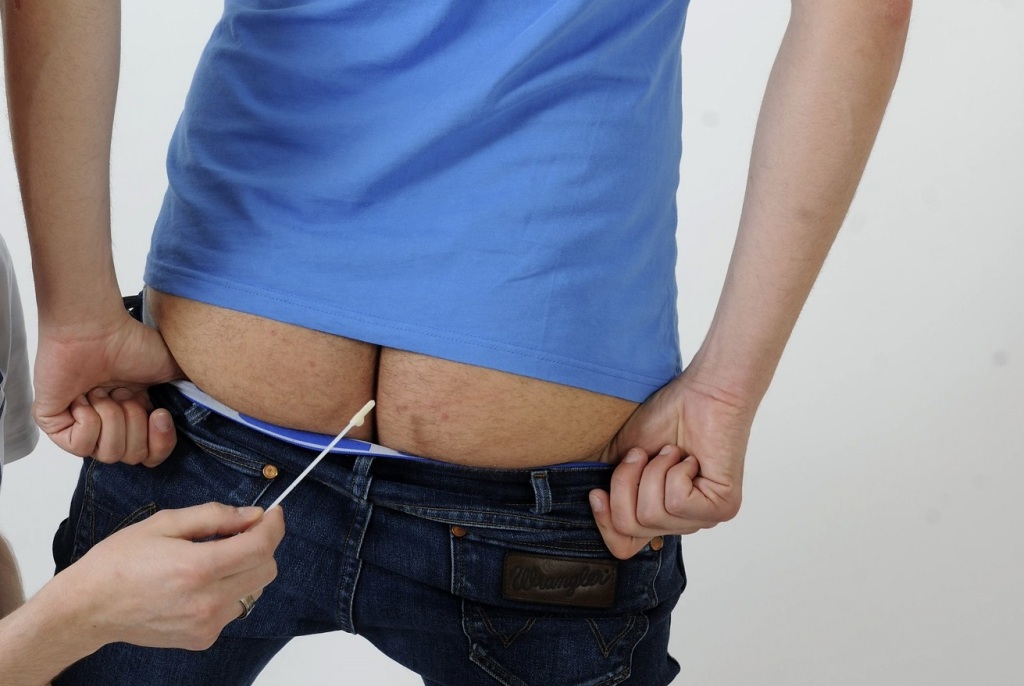
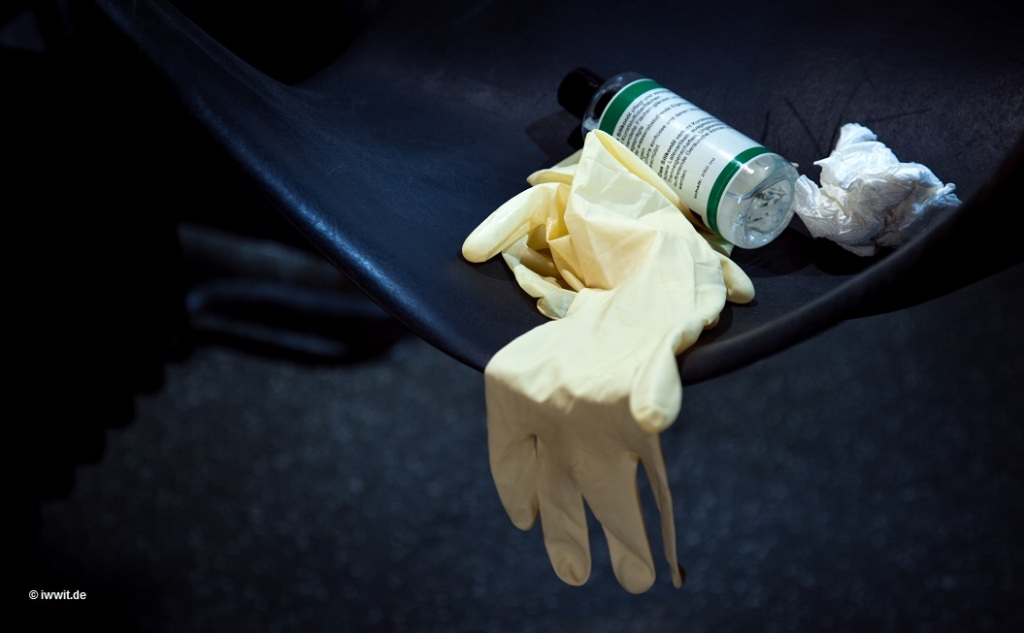
Sometimes you have to take swabs - for example, when you have yourself tested for sexually transmitted infections. (Photo: iwwit.de)
A topsy-turvy world: anal intercourse with personal lubricant increases the risk of contracting HIV, according to recent reports in some online media. The story of a false report. And the facts.
The conclusion is that after taking into account factors such as age, gender, origin and sexual orientation, the use of certain lubricants during unprotected anal intercourse MAY increase the LIKELIHOOD of contracting a sexually transmitted disease caused by bacteria or viruses. It is POSSIBLE that the ingredients of the lubricants kill the cells of the upper intestinal protective layer and thus facilitate infection. In any case, similar substances IN THE LABORATORY had killed such cells. IF all this is the case, the risk of infection during UNPROTECTED anal intercourse with lubricant is about three times higher than without lubricant.
The scientists even qualified the results themselves: The number of study participants was too small to generalise, their backgrounds were not diverse enough, the number of lubricants tested was too small and the observations were not long-term enough. However, there is a trend that would more than justify further studies. Many analyses of studies end with a sentence like this.
False reports
Nevertheless, some internet media soon reported that the use of personal lubricants significantly increases the risk of infection during anal intercourse. Due to a misunderstanding and translation error, the German media also spoke of a 20 times higher risk. However, the first sentence of the press release only stated that the risk of infection was 20 times higher with unprotected anal intercourse than with unprotected vaginal intercourse.
As is the case in the age of the internet: the false reports multiplied and soon there was a heated debate in the scene as to whether spit and a prayer in the evening was not better protection than lube after all.
Lubricant is part of anal sex with a condom!
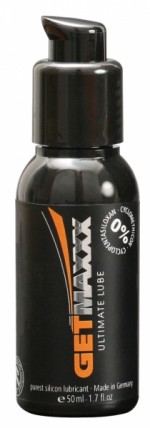
In short: No, definitely not. The vast majority of anal intercourse between men takes place with a condom. Lubricant is essential because the rubber breaks much more easily without it. Firstly, shreds of rubber on the cock never look good, and secondly, they damage the partner's intestines much more than any lubricant - and thus increase the risk of infection. Apart from the fact that the condom then of course no longer has any protective effect. That's why the following still applies: when having anal sex with a condom, lube is a must!
Anal intercourse without a condom carries a high risk anyway if you don't know your partner's HIV status. The question of lubricant is of secondary importance.
A study by Stiftung Warentest, which tested most of the personal lubricants available in Germany for skin and mucous membrane compatibility in 2007, can also be read as an all-clear. Almost all of them scored "very good" or "good".
Ficki Ficki, Ouch Ouch
Incidentally, heterosexual women have the most unprotected anal sex: In industrialised nations, 15 percent of all women between the ages of 15 and 55 also like to let their visitors in the back. They are obviously also familiar with the summer hit by Berlin's drag superstar Nina Queer with the beautiful title "Ficki Ficki, Aua Aua" and therefore use a lubricant. However, in less than ten per cent of cases in combination with a condom.
And an interesting side note: Most of the personal lubricants bought in German pharmacies, drugstores and sex shops are bought by women over 50, but this has little to do with anal intercourse, even if they have interested partners or gay sons. The ladies simply want it to keep going even after the menopause.
(Paul Schulz)
The press release of the "International Microbicides Conference"
For more than six months, Milan has been one of more than 5,000 gay men taking part in the international PrEP study DISCOVER to participate. The aim is to test whether the combination drug Descovy is just as suitable for HIV pre-exposure prophylaxis ("pills to protect against HIV") as its predecessor Truvada and the Truvada generics. We accompany the 26-year-olds with interviews over the three years of the study.
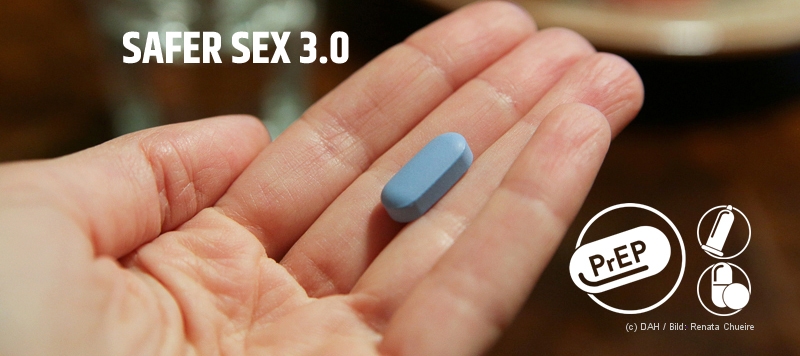
As part of "Safer Sex 3.0", various gay men on the IWWIT blog talk about how they protect themselves against HIV, whether with condoms, PrEP or protection through therapy. We encourage everyone who wants to protect themselves against HIV to choose the best safer sex method for them.
Milan: No, that was ultimately a false alarm, the doctor in charge thought she had detected an unusual value, but it turned out to be completely harmless.
I had waited so long for PrEP that I was actually a bit paranoid and worried that I would now have to stop PrEP. But this worry was completely unjustified.
How have you tolerated the PrEP medication so far? You don't know whether you are receiving Truvada or the follow-up preparation Descovy.
I tolerate the pills very well and have had no side effects so far.
You have now been taking the pills every day for several months. Do you still have to remember to take them every morning?
For the first five or six months, I automatically thought about it every day. In the meantime, however, I had a lot on my mind and therefore forgot to take the tablets twice. That annoyed me a bit - even though it doesn't affect HIV protection if you forget to take the medication once. That's how the doctor explained it to me.
I now have a tablet box with a compartment for each day of the week. It's right in front of me at my desk, so I can't miss it under any circumstances.
"PrEP has now become something completely normal for me"
Are you still thinking about taking PrEP? Is it still something special?
No, it's now something completely normal for me and has become a part of my life. The initial excitement has subsided. It would also be unrealistic to expect this feeling of excitement to last for the entire three years that I am expected to take part in the study.
When you started PrEP, you had good reason to feel part of a group with very special freedoms.
That has changed at the latest, since PrEP from 50 euros is available to everyone in the pharmacy! This means that PrEP is now theoretically available to everyone. That's great.
However, it's not just about sexual freedom, it also means a lot to be protected from HIV. PrEP also frees you from always having to think about HIV and the fact that this virus could mark your body with this "positive" label for the rest of your life - even though the medical possibilities now enable people with HIV to lead a fairly normal life.
Of course, there are some benefits as a study participant, such as the regular comprehensive health checks and free medication. I'm grateful for that. But that's about it. I'm very happy that PrEP has now made it into pharmacies on a regular basis and that many more people can benefit from it. It's right and important that it's available to everyone.
Have you also got used to the sexual freedom that PrEP gives you?
"The fact that I don't always have to think about condoms is still very liberating for me today."
The fact that I couldn't always keep myself in check was the reason why I wanted PrEP. It's not that I don't have sex with a condom, but that happens quite rarely in comparison.
The fact that I don't always have to think about condoms is still very liberating for me today. I don't want to imagine what it would be like again without PrEP.
However, I don't see PrEP as a lifelong solution either, if only because of the possible effects of the medication on the body [Editor's note: Most people tolerate PrEP well]. After all, researching these side effects is also the reason for this study. When it is over, I will look at the results and then possibly decide to continue with PrEP.
Are you concerned about possible unexpected long-term effects?
Developments in medicine, and especially in pharmacy, are moving at breakneck speed. That's why I'm sure that over the years there will also be PrEP drugs that place even less or no strain on the body.
Today, we may be made aware of the possible risks of taking certain medications for years that will no longer exist in the foreseeable future. That's why I'm not really worried about long-term side effects and enjoy the opportunities I have. Because I'm young now, not later.
Do you have more sex with more partners with PrEP than before?
"If I go to a sex club today, ..."
Much more! When I go to a sex club nowadays, I sometimes actually have sex all night long, again and again and with different people. Before, without PrEP, I went there too, but I usually only had sex with someone once.
When you go to clubs like this today, do you tell the other men that you want to have sex without a condom?
I always make it clear to the guys straight away that I prefer bareback sex, and usually also that I'm on PrEP. But normally people don't talk about it at all. When locals go to places like this to have sex, the condom is usually no longer part of it. At least that's my experience, that's the scene here. I don't know of any other place in the world that is as sexually free as Berlin.
By "free" do you also mean the freedom offered by the protection provided by therapy and PrEP?
"Conversations like that can really ruin the erotic tension."
Exactly, you don't have to talk about these things as foreplay: whether with or without a condom, or why it works without one. Such conversations can really ruin the erotic tension.
This happens, for example, when you encounter a tourist (laughs). You're so used to having sex without a condom in places like this that I'm completely surprised when someone suddenly pulls out a rubber while making out.
How do you react then?
Should I be honest? For me, that's usually the end of it. If the chemistry is really good, I can of course have sex with a condom, but it just doesn't make me really horny and I don't enjoy it that much.
But then I'm also not in the mood to have an educational discussion about PrEP. It's not the place, it's not the time and it's not my job.
I've tried that a few times, but it just doesn't work in a situation like that and, frankly, I don't feel like it either. After all, I came there to have sex and not to have to explain my way of having sex. I'm not alone in this experience, by the way.
That sounds a bit arrogant.
"I quickly photographed my box of medication and sent it to him, so he was reassured."
I am aware of that. Of course, I know that we are much more advanced in these matters here and therefore also privileged. Someone for whom sex automatically means sex with a condom is naturally overwhelmed by the situation.
They may have never heard of PrEP, or only heard a little, and understandably harbour doubts about its effectiveness. But I doubt that I am the right person in this place, in this context, to communicate these medical facts in a trustworthy manner (laughs).
"I could well understand why he was so panicked. "
So I can't convince him of the effectiveness of PrEP, nor do I want to persuade him to have sex without a condom. It won't lead to anything and will only ruin the evening for both of us.
Once someone was unsure, but he ended up having sex with me. The next day, he wrote to me on Facebook: "Are you really on PrEP?" I could well understand why he was so panicked.
If you simply don't know much about PrEP, a situation like this is naturally upsetting. I then have to think about how I freaked out in the days before PrEP when I did have sex without a condom. So I quickly photographed my box of medication and sent it to him, and he was reassured.
More sex with a higher number of partners mathematically increases the risk of contracting sexually transmitted infections (STIs). What is your balance sheet like now?
Very manageable, I think - in relation to how much sex I've had since I've been on PrEP.
And what does that mean in figures?
"The infections were diagnosed at a very early stage and then treated immediately."
In the very first month Chlamydia and three months ago I had gonorrhoea in my throat. Both times the infections were detected during the quarterly STI examinations that are part of the study.
The infections were diagnosed at a very early stage and then treated immediately. But talking about STIs in connection with PrEP is actually irrelevant here, because gonorrhoea and chlamydia, for example, can also be transmitted during licking and blowing, regardless of whether you are on PrEP or using a condom. I could also have got the infections during sex with a condom.
But when we talk about PrEP, we are talking about HIV protection. And as far as HIV protection is concerned, PrEP is at least as safe as a condom, if not more so. It therefore makes no sense to use the risk of infection from other STIs as an argument for rejecting PrEP.
How frequent are the visits to the doctor as part of the study?
Every three months.
What exactly is happening?
In the waiting room, I first have to fill out a questionnaire. The questions are always the same: How many people you've had sex with without condoms since your last examination. How many times you have been active or passive during anal intercourse. Whether you have taken the tablets every day or how often you have skipped taking them and why.
During the blood test, we are also asked in person whether there were any side effects. And we are always offered condoms, which we can take with us free of charge if we want to.
Is there anything about these quarterly check-ups that is not going quite so smoothly?
"You're going to laugh now..."
There really is such a thing, and you're going to laugh now: it's the urine samples. But if I go to my appointment in the morning, of course I've already had a wee, and then I can't go to the surgery. I feel most sorry for the people who only have their appointment in the afternoon. They must be completely hungry! We're not supposed to have eaten for five to six hours beforehand.
Another study participant told me that he sometimes felt uncomfortable being asked detailed questions about his sex life by female doctors during check-ups.
I have no problem with that. These doctors are experienced and there will be nothing that could surprise them (laughs). I think someone who has a lot of sex shouldn't be so uptight if they have to have their bum looked at by a doctor twice a year for the sake of their health.
There was only one situation that seemed a bit strange to me, namely when a doctor did an anal swab on me. She then asked me if I would like to do it myself in future. They showed me how to do it, and it really isn't an art.
"I hadn't expected such vehement comments"
After our first interview was published, there were quite a few heated comments on Facebook. How did you perceive it yourself?
I was prepared for the fact that there would be negative comments from people who are fundamentally critical of or opposed to PrEP. But I hadn't expected that some of them would be so vehement.
I was therefore pleased that people got involved in the discussion and supported my position. However, I then also tried to look at the interview from a distance and was unsure whether one or two sentences might come across as naive or irresponsible as a written interview, even though that wasn't the intention. However, it was important to me during our interview to answer as honestly and clearly as possible.
I was particularly struck by the fact that the highly critical commentators themselves often lacked key information about PrEP.
"I was particularly struck by the fact that the highly critical commentators themselves often lacked key information about PrEP."
And I have the impression that some men react so emotionally and angrily because - perhaps without realising it - they are secretly jealous and angry that PrEP was not available when they themselves were young. That's why factual arguments and information don't get you much further in the discussion.
Does that annoy you?
I can even understand this behaviour to a certain extent. As you get older, it becomes more difficult to go along with or accept new developments, especially if they call into question or change things that were previously a fixed, fundamental part of your life.
This applies not only to medical advances such as PrEP, but also, for example, to technical innovations that people are not familiar with and therefore ridicule or reject as unnecessary. I have already realised this myself. For example, I don't understand how young people today can spend so much time on Instagram. For me, that's complete rubbish. It's an important social medium for them.
So in a way, it is completely normal for us to defend the fixed coordinates of our own lives. For many gay men, this also includes the ingrained understanding of safer sex as sex with a condom.
But that doesn't change the fact that the younger generation, like me, will take new developments like PrEP for granted as a natural form of safer sex.
And just because I or others want to take advantage of advances in the pharmaceutical industry that allow us to experience sex more intensely - i.e. without a condom and without the risk of HIV - does not make us irresponsible people. Taking PrEP proves exactly the opposite.
Safer Sex 3.0: Condoms are probably the best-known safer sex method to protect yourself from HIV. Many gay men still successfully use the rubber today. One of them is Enrico, 36, from Leipzig. Here he tells us how he deals with the topic of safer sex and why he still prefers to use the rubber. Condom back.
As part of "Safer Sex 3.0", various gay men on the IWWIT blog talk about how they protect themselves against HIV, whether with condoms, PrEP or protection through therapy. We encourage everyone who wants to protect themselves against HIV to choose the best safer sex method for them.
"I had my first gay sex when I was 17, when I met my boyfriend through a box number ad and we didn't think about safe sex at all. I only learnt about HIV and the risk of infection when I moved from the provinces to Erfurt a few months later. I then took an HIV test with my boyfriend at the time. We were both negative and decided not to use condoms in the relationship. We were young, blinded by love and believed in absolute fidelity. Apart from that, we didn't know anyone who was HIV-positive.
Loyalty as protection? Enrico sees it differently today
The virus was a completely abstract danger back then. The relationship lasted just under a year and in the end I realised that my partner had cheated on me and caught various sexually transmitted diseases. That really shook me up, because the naive trust that nothing could happen to you in a relationship was shattered.
"When I'm driving, I wear my seatbelt without giving it much thought. It's the same for me with the condom."
This made it clear to me that I would always use condoms from then on. For me, condoms have simply been a part of sex ever since. I grew up with it, if you like, and have internalised it. It's like driving a car. You put your seatbelt on without giving it much thought. You just do it.
In a relationship: a better feeling without a condom
The exception is my relationship. I've been back in a relationship for five years and we actually don't use condoms. We keep hearing that sex without a condom is like a liberation and that you feel completely different without it. Within the partnership, sex without a condom actually gives you a more intense feeling of closeness - but less on a physical level than on a psychological level.
However, if we get someone to join us or we have sex with others outside of the relationship, condoms are a matter of course for us. I always have condoms at home and ready to hand, and if they are needed, it's just a practised hand movement or two. As a result, there are no unpleasant interruptions and the sexual tension and atmosphere is therefore not disturbed at that moment. In case of doubt, my passive partner, who may already be completely relaxed in front of me, doesn't even have to notice how I put the rubber on. I always make it clear in advance that we are using one anyway. So there's no need to talk about it at all.
The best form of safe sex for me
"For me, there's a lot in favour of condoms. For example, it also reduces my risk of contracting other sexually transmitted diseases."
For me personally, condoms are the best form of safer sex: they are easy to use, they are always and everywhere available and they have no side effects - unless you have a latex allergy. And even then there are now latex-free alternatives. But for me, two other things are also important: I can see exactly how I'm protecting myself. If I have sex with someone who is HIV-positive but no longer infectious, I have to trust them so that I can skip the rubber. On the other hand, the condom also reduces the risk of catching other sexually transmitted diseases.
"And yet: regular checks are part of it for me."
And at the same time, I know that I can of course also catch gonorrhoea through oral sex, for example. That's why I regularly get tested for sexually transmitted diseases. For HIV anyway. That's just part of it for me.
For Enrico, 36, the condom is not out. Quite the opposite.
And PrEP? Rather nothing for Enrico
"PrEP would be too expensive for me!"
One PrEP for example, does not reduce the risk of contracting other sexually transmitted diseases. But it's also out of the question for me for other reasons: getting the medication, the doctor's appointments and blood tests that are necessary, not to mention the cost factor - it's all too time-consuming for me.
Of course there are now more and more PrEP users in the scene. But it has never happened to me that a sex date has been cancelled because I am so "conservative" and insist on condoms - and don't take PrEP myself. On the contrary, I often get rather positive feedback and people think it's good that I've thought about safer sex and want to consciously protect myself."
The rule of thumb used to be: only have sex with a condom! There are now other options for protection against HIV. We asked around to find out how safer sex is practised today
Condoms: tried and tested and widely used
Sex is known to be the most beautiful thing in the world. And the fact that HIV can be transmitted during sex doesn't have to spoil the fun for anyone. After all, there are a whole range of ways to protect yourself today. The good old condom is still the most tried and tested and most widely used method.
"Without rubber - I'm not up for that"
Kathrin always has her personal stash to hand: "I can find the little box under my bed even in the dark and in almost any body position," reveals the 28-year-old, laughing coyly. She also keeps two well-packed condoms in her rucksack and handbag. "Just in case. You never know who you might meet," she says with a cheeky grin. "I just don't want to have to rely on my one-night stand, who I might meet in a club, being equipped with rubbers. And without any - I'm not up for that."
The fear of HIV transmission only plays a subordinate role for Kathrin. "I can also easily do without the clap."
A more relaxed sex life thanks to PrEP
For Matthias*, too, sex with a condom has always been a matter of course. And yet it has already happened to him that the condom was left off unplanned - for example in the gay sauna. "All of a sudden, my head is switched off during sex and only my cock decides what happens. Afterwards I regret it and I panic slightly: what if something has actually gone wrong?"
To avoid such situations, Matthias has been taking HIV protection pills, known as PrEP, for some time. Taking the HIV medication regularly prevents the virus from multiplying in the body cells of HIV-negative people - and thus protects them from infection.
His sex life is much more relaxed with PrEP. And yet the condom has not become obsolete for him.
For Matthias, this method of protection has made his sex life much more relaxed. However, the classic condom is far from obsolete for him. "The condom is a must-have for me, but PrEP is a nice-to-have: a good way to protect yourself if you don't use condoms." He therefore believes it is important to be well informed about this method of protection - and to seek medical advice when taking PrEP.
Double protection thanks to PrEP and "protection through therapy"
For Jutta*, PrEP offered an opportunity to have condom-free sex with her HIV-positive partner Gerd - and to be doubly protected. This is because her partner has been taking HIV medication for a long time. As a result, the amount of virus in his blood is so low that HIV is no longer detectable in him: HIV can therefore not be transmitted sexually.
"It was very important to me to be able to feel my husband as intensely as I would ideally like to. The rubber also reminds you that there is a danger - no matter how irrational the thought. I knew that Gerd was no longer infectious, but when it comes to emotions, the mind is sometimes simply inferior."
Protection through therapy works
This "gut feeling", which prevented Jutta from letting go completely despite knowing better, was something Jeff also had at first in his relationship with an HIV-positive man. However, he informed himself intensively about the non-infectiousness of people with HIV who are successfully treated and was quickly convinced of the protective effect of HIV therapy.
"It was friends we told about it who were more sceptical. We had to explain it to them first."
"'Protection through therapy' requires deep trust"
When Stefan found out about his HIV infection seven years ago, he first had to come to terms with the news, but he didn't go into shock. "I realised that I wanted to start HIV treatment quite quickly. Also so that I can have sex with my boyfriend without a condom once the viral load has fallen below the detection limit," says the 45-year-old. "In all three relationships I've had since then, I've slept with my partners without a condom. And all three are still negative today." For him, this is the best proof that "protection through therapy" works.
Jeff is now single again. He now handles safer sex very differently, depending on the situation. For him, sex without a condom is only conceivable with HIV-positive men who, like his ex-partner, are below the detection limit. "That presupposes that you know each other very well and that there is a deep level of trust," explains Jeff. "I could never be sure about one-night stands, and that's why it still only happens with a condom."
However, this is not a major problem for him, so PrEP is not an urgent wish for him at the moment. "But who knows how I'll feel about it in a few months' time." Just having the option is an enrichment for him. Because ultimately, says Jeff, the HIV-negative person has to decide how they want to maintain this status - whether through PrEP, "protection through therapy", the condom or a combination: "Safer sex is all of these ways," he says.
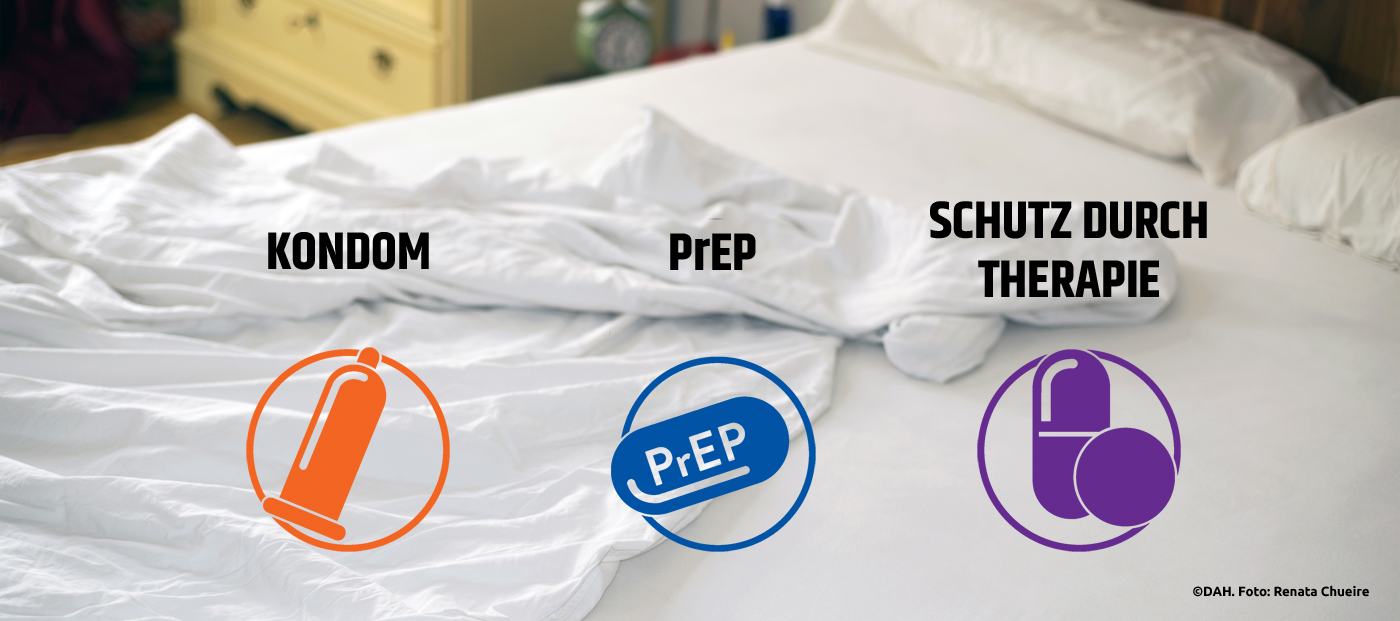
Safer Sex 3.0: The three effective methods of protection against HIV
More information can be found on the website www.iwwit.de
The coronavirus crisis has dominated our everyday lives for more than a year. Hygiene measures, contact restrictions and the closure of safe spaces can be particularly stressful for gay men. Stefan Meier, who works as a counsellor at gay checkpoints Man-O-Meter works in Berlin-Schöneberg. We had a chat with him.
IWWIT: Stefan, you conduct an average of 150 counselling sessions a year. What concerns do the men who come to you have?
Stefan Meier: We are one of the few facilities that are explicitly aimed at gay men. The reasons for visiting us are as varied as gay life itself. Some men come to us with questions about coming out, dealing with anxiety and depression, or anything else that has to do with gay life. sexual health turns. We see ourselves as a kind of first aid centre for those seeking advice. They often come to us two or three times. If their issue cannot be resolved during this time, we refer them to counselling centres or therapists. However, mothers also come to us from time to time whose children are in the Coming out are located.
Sexual health means more than the absence of illness.
What do you mean by sexual health?
This is getting almost philosophical now. For me, sexual health definitely means more than the absence of illness in the sense of viral or bacterial infections. Being sexually healthy also means that I enjoy my sexuality, know myself and my body and know what gives me pleasure and what does not. It also means that you can take the opportunity to live out your fetishes in a self-determined way.
What do you mean by "self-determined living"?
By that I mean exactly that: making it clear what I like and what I don't like, but also knowing what makes my sex partner horny and what I can or want to give them. If someone engages in a sexual practice like fisting, they should know whether they really want it and find it hot. It often happens that we do things because we are afraid of rejection and don't know how the other person would react to a rejection. If someone doesn't like anal sex, that's perfectly OK. The same applies to the use of substances during sex.
It often happens that we do things because we are afraid of rejection and don't know how the other person would react to a rejection.
Have you noticed a change within the community since the first coronavirus lockdown?
There is a great deal of insecurity, which manifests itself in very different ways. People who are depressed and are always told that they should be in contact with other people, and have also learnt that this helps them, perceive the restrictions as very oppressive. They miss the closeness and interaction with others. Anxious people are unsettled by the flood of news about corona. Many gay men are currently being thrown back on themselves as they lack a connection to a family environment - the closure of bars, clubs, saunas and other queer facilities means that places that are important for their mental health are no longer available.
The closure of bars, clubs, saunas and other queer facilities means the loss of places that are important for the mental health of gay men.
Why are these places so important, especially for gay men?
A young gay man, who still lives at home with a family that does not accept his gayness, now has to spend more time with his homophobic family. Conflicts are inevitable because he lacks support and a safe space where he can be who he is. The so-called "scene" is often criticised for being commercialised. At the moment, however, we are realising how important its social function is.
What advice do you give your clients who feel lonely due to the crisis to get through this difficult time well?
First of all, it is important to recognise that these are difficult times. It also helps to internalise that many people are in a bad way at the moment and that many feel lonely. I also advise my clients to realise that there is little they can do to change the situation. They can't do much more than keep their distance, wear a mask and wash their hands. It is currently more helpful to focus your attention on things that you can control and change.
Are there any tips other than thinking positively?
If my friends are important to me and I can't see them, I just invite them round for a cocktail via Zoom. If I enjoy wellness, then it might be nice to take a bath more often and I can perhaps pimp my bathroom a little and create my own wellness oasis. It often helps to consciously create routines that help to structure everyday life.
It often helps to consciously create routines that help to structure everyday life.
Are couples doing better than singles at the moment?
Yes and no. Couples are currently facing the challenge that they may be spending more time together than before. If they are both working from home and the flat becomes an office, this can also be difficult and lead to conflict.
How can couples cope with this situation?
One option is to see how I can support my partner - professionally or in other stressful situations. Another option is to rediscover each other as a couple and see what you can do together. However, it is also important to give each other space and allow each other to retreat. It can also be helpful to try to be a little more generous with your partner and not put every word on the gold scale. Sometimes you should also try to keep reminding yourself that behind accusations often lies the communication of needs.
What is your tip for people who are spending the next lockdown as singles?
Singles should think about what is good for them and do it more often. It is still possible to meet up with a friend, go for a walk or arrange to cook a meal at home. Or, if a man wants to, he can find a Fuckbuddywith whom you can have sex and thus satisfy your need for sex and closeness. The corona test programme is now also being expanded in German cities and can be used for this purpose.
IWWIT is here for you! The queer scene has also been affected by the coronavirus pandemic, whether through possible loneliness in isolation or financial difficulties.
But we won't leave you hanging! That's why we have launched our #WirFürQueer campaign: You are not alone! We help each other! Together we can make it through these tough times! You can find more information at iwwit.de/we-for-queer.
On gayhealthchat.com we also offer advice every day between 5 and 8 p.m. - quickly, confidentially and free of charge.
Transition refers to the harmonisation of trans* people with their actual gender. To put it somewhat casually, it means making visible to the outside world what has long been clear on the inside. Transition is usually a year-long process - which can be very challenging for the trans* person. The three typical levels are briefly outlined below.
Social transition: from coming out as trans* to appearing in public Coming out as a trans* person - how does it work? Whether as a child, teenager or adult, at some point a person realises: "There's something wrong with me, everyone thinks I'm 'male' or 'female', but I know better." This inner coming out is often not easy because there are no role models, hardly any children's or school books talk about it and there are only a few role models. If a person then realises ("I'm trans*"), it's usually time for the external coming out, namely telling other people what's going on: in the family, among friends, at work, at school... The feedback is usually different. A positive experience can always be followed by a negative experience due to devaluation, not being taken seriously or, unfortunately, discrimination ...
The external coming out makes visible to the outside world what is usually already clear on the inside, supported, for example, by different ("gender-typical") clothing, a different appearance, accessories such as baseball caps, binders (fabric on the upper body that makes the chest area appear flatter) or packers (from socks to dildos, anything that looks like "something in your trousers"). In public spaces, a lot changes for the trans* person: from being addressed by their new first name (or not), to being looked at on the street or at work, to going to a public toilet and the possible hostility that comes with it.
Medical transition: from testo to gender reassignment surgery If you have health insurance, the costs of hormones and gender reassignment surgery are covered by the health insurance companies. However, the conditions for approval are high: one year of accompanying psychotherapy before hormones are granted, one and a half years before surgery is covered (e.g. mastectomy, i.e. male breast reconstruction, hysterectomy or penoid reconstruction). With the diagnosis F.64.0. the accompanying psychotherapy, it is certified to be "transsexual".
With prescription testosterone (e.g. as a gel that is applied daily or as an injection that is given every 14 days or every three months, depending on the testosterone preparation), the body changes: the voice becomes deeper, including the voice break, beard growth occurs, muscles and fat are redistributed.
Counselling centres run by and for trans* people provide more information: how to find a good accompanying therapy, how hormones work, where to find competent surgeons and answers to all medical questions.
Legal transition: ... to the new first name Changing your first name from Susanne to Michael, being authorised by the state to change your civil status in the civil register from "W" (as in female) to "M" (as in male) or vice versa - both have been possible in Germany since 1981 under the Transsexuals Act (TSG). It has been heavily criticised by human rights and trans* organisations because: the process of getting a new first name is too long (up to one and a half years), too expensive (up to a few thousand euros), only goes through the local district court and involves not one but two assessments, usually by psychotherapists commissioned by the court.
In regions where there is not a large selection of trans*-friendly assessors, it happens from time to time that the trans* man or trans* woman has to show their wallet, belt or stockings to check whether the person is "male" or "female" enough. Sounds absurd? It is. Following the court proceedings, the new first name becomes legally binding and all important documents have to be changed, whether driving licence, certificates or identity card. Sterilisation has only been no longer required to change marital status since 2011, when the Federal Constitutional Court finally deemed this operation to be an infringement of the physical integrity of trans* people.
If taken together with amiodarone, a life-threatening reduction in heart rate may occur. Although amiodarone is a drug used to treat cardiac arrhythmia. This was announced by the US pharmaceutical company at the end of March.
The background to this warning is nine cases to date in which patients of one of the two Hepatitis C-(both contain the active ingredient sofosbuvir) together with the heart medication amiodarone and complained of an abnormally slow heartbeat as a result. One of the patients died of cardiac arrest and three others required a pacemaker.
According to Gilead three of the nine patients took the combination preparation Harvoni (sofosbuvir + ledipasvir). Five took the drug Sovaldi (sofosbuvir) in combination with daclatasvir. And another patient took Sovaldi in combination with Olysio (simeprevir).
According to the Wall Street Journal, there are between 1,000 and 1,500 patients in the USA who are taking both the heart medication and the active ingredient sofosbuvir. A total of 250,000 to 300,000 patients are currently being treated with amiodarone in the USA. In Germany, this active ingredient is marketed as Cordarex®, Amiohexal® and Amiogamma®, among others.
Gilead recommends that patients be observed as inpatients for the first 48 hours after starting therapy. This applies to amiodarone as well as Harvoni or Sovaldi in combination with other DAA agents (DAA stands for direct acting antiviral). And thereafter, the heart rate should be monitored on an outpatient basis or by the patient themselves for at least another 14 days.
Due to the long half-life of amiodarone, patients who stopped taking this drug shortly before taking Sovaldi or Harvoni should also continue to be monitored.
Warning on the use of its hepatitis C drugs Sovaldi and Harvoni.
Franz and Manuel like fisting. If their hand is up their arse, they often have hepatitis C in their head. This is because being HIV-positive makes it easier for them to get a co-infection. Here they explain how they enjoy their sex sessions with caution.
Franz doesn't like it when it's completely dark during sex. "I want to have enough light to see if there's a noticeable trace of blood on my glove." Franz is 56 years old, HIV-positive, a leather fan and Franz likes to fist. "I've become a few per cent more careful recently," says the man from Augsburg. Within three months, he learnt from four good friends that they had contracted hepatitis C. "After that, I also went for a check-up as a precaution - out of turn." Franz has himself tested for sexually transmitted diseases twice a year anyway, including a hepatitis C test. "But it was nothing," says Franz with relief.
Gay men with HIV are infected with hepatitis C more frequently than HIV-negative men. One possible transmission route: sex parties where the partners change frequently. Franz's impression: "It's a mixture of fist and fuck scene. If it goes on all night, it often doesn't stop at a fist. And minor injuries always happen during fisting."
Safety belt during the fist session
Manuel (30) from Berlin also likes to fist. He usually meets up with three fuckbuddies for a "session". He caught it in 2011: hepatitis C - a typical co-infection, as Manuel is also HIV-positive. The treatment lasted a year. It had severe side effects, but was effective: the viruses are gone, Manuel's doctor has just confirmed that he has "liver values to show off" again. But the intense experience remains in his mind. "Sex after hep is different to before," says the journalist. "When I start playing with new people now, I first see how they act," he reports.
"Fisting is a sexual game where relaxation in the mind is important," says Manuel. "Fisting is about the deep penetration of your partner and being filled up inside," explains Manuel. "Whether the hand inside me is wearing a glove or not is not so important." The glove even creates a little extra moment of security - and helps you to relax.
"Hardly anyone feels affected by hepatitis C"
Manuel made no secret of his hepatitis C infection. The information was even written in his Gayromeo-profile. "The reactions were neutral," he recalls. "In the worst cases, my enquiries were kindly moderated." Only once was there a user who bombarded him with messages: "You are irresponsible! You're damaging the solidarity system! "But I wasn't the only victim," says Manuel. "There are always a few crazy people online."
Overall, the gay fetish community reacts rather indifferently to the increased risk of hepatitis C, as Franz has also observed. "Hardly anyone feels affected by hepatitis C. People say to themselves: I've got nothing to do with fisting anyway," says Franz. And unlike HIV, hepatitis C can be cured. "You have to deal with HIV for the rest of your life," says Franz, who has been living with HIV for over 20 years. "As an HIV carrier, you're still more discriminated against in the scene."
No open discrimination, but polite distancing - this is how most men react when they find out about hepatitis C. However, Manuel believes that retreating is a crucial mistake. "You never find out how the infection happened and how you can protect yourself." And the other person misses out on the chance to tell you what they are going through. "Hepatitis C treatment is no walk in the park," emphasises Manuel. "Everyone has moments when they're struggling and need a hug or a listener." That's why Manuel urges: "Relax! Talk to each other. Educate yourselves." The exchange can enrich both sides. "Knowing what's going on gives you a sense of security. And this good feeling also helps you to have better sex."
If you want to know what else to look out for when fisting so that it stays "safer", you can find out more on the I KNOW WHAT I DO campaign website. Here you will also find information on BDSM, group sex and pissing: www.iwwit.de/fetisch
Gay men with HIV are infected with hepatitis C more frequently than HIV-negative men. One possible transmission route: sex parties where partners change frequently.