
Category: Community

  • Against shame and sin

    Against shame and sin

    The TV series "It's a Sin" shows LOVE IN TIMES OF AIDS

    The counterpart to "Queer as Folk": the TV series "It's a Sin" looks back to London in the 1980s, when the gay scene there was also overrun by AIDS. A masterpiece that not only tells of the past, but also of the here and now.

    (Spoiler warning: This article contains spoilers for the series "It's a Sin")

    You don't need prophetic abilities to predict the future of this series: it will soon be part of the gay community's cultural memory, just like "Pose" or "Queer as Folk". In other words, TV series that also tell queer stories and history in such a way that they themselves create lasting memories.

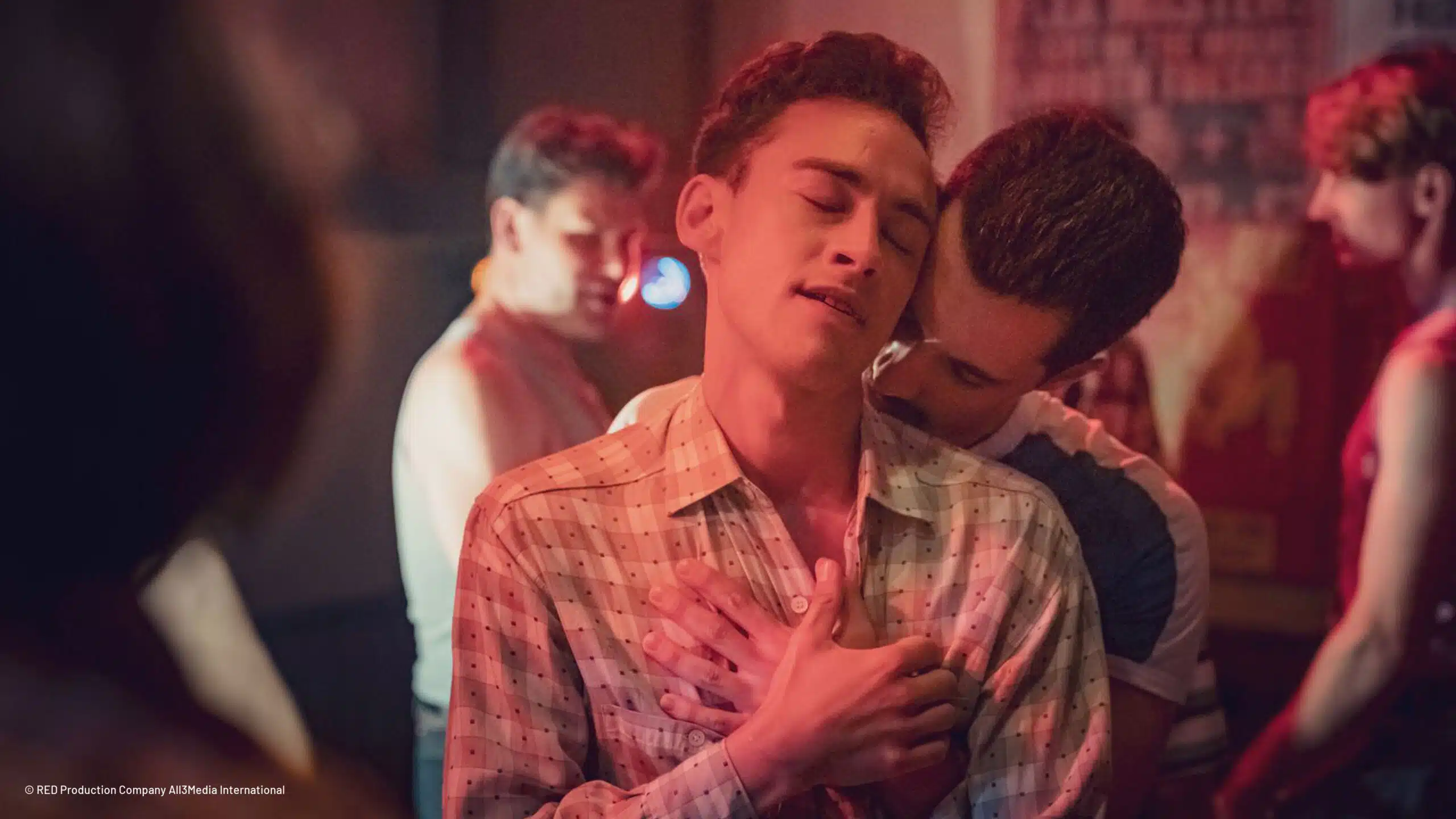
    Scene from episode 2 of the TV series Gregory, Colin, Richie, Jill and Ash (from left to right) (© RED Production Company & All3Media International)
    Scene from Episode 2 Gregory, Colin, Richie, Jill and Ash (from left to right) (© RED Production Company & All3Media International)

    Queer history as a TV series

    Because the characters in "It's a Sin" make you feel the excitement up close. With their departure into the adult world and the euphoria of sexual liberation and self-awareness. You get so close to them in the five episodes! We accompany them so intensively through the highs and lows that you almost inevitably feel part of this queer family of choice.

    And above all, Russel T Davies, the creator of this TV mini-series, repeatedly manages to create scenes and images that literally burn themselves into the viewer's memory and will stay with them for a long time to come.

    Enduring inner contradictions

    Also because the overlapping feelings of rebellion, happiness, despair, incomprehension and hope are often captured in a single image. For example, when the parents of party-loving ticket inspector Gregory build a funeral pyre in the garden after his death. They burn his bed and all of their son's personal belongings there, including his childhood photos and snapshots with his friends in faraway London. As if they could erase his gayness and his AIDS.

    Or Ritchie, who didn't dare to pick up his test result and ignored all the signs. Only now that the disease has broken out does he have the courage to reveal himself - in his very own way - to his closest friends: "I wanted you to be the first to know: I'm going to live!"

    "I wanted you to be the first to know: I will live!"

    Olly Alexander (who many will know as the frontman of the band Years & Years) puts everything his character has to endure in terms of inner contradictions into this short sentence. The relief of finally being able to confide in the most important people, the shame of having lied to them for so long and the fear that his future could be very short. And then there is also the defiance of not wanting to let them get him down and rob him of his zest for life.

    Gay television history for a broad audience

    And because this does not leave the audience untouched, this scene also becomes an unforgettable moment. Russel T Davies not only knows his craft, he also knows how to use it masterfully - and that means writing for a broad audience without compromising on content.

    Consciously not reducing gay life and love to HIV and Aids

    He had already achieved this with series such as "Cucumber", "A Very English Scandal" and "Years and Years" and above all, of course, with "Queer as Folk". With the latter series, the British director and screenwriter wrote gay television history over 20 years ago. It was so successful that an even more internationally successful US remake was made a few years later.

    At the time, Davies had deliberately refrained from addressing HIV and Aids, but instead wanted to gay life and love without defining it by the illness.

    A new world in London in the 80s

    For him, however, it was now time to remember those years and at the same time come to terms with his own story. Davies has obviously packed a lot of his own story into Ritchtie, the smart, good-looking 18-year-old who opens up a new world in the gay scene of London in 1981 and enjoys the sexual opportunities that present themselves to him to the full. And Jill (Lydia West), Ritchie's best friend who, like him, is also studying acting, also has a real-life counterpart.

    Scene from episode 2 of the TV series Roscoe © RED Production Company & All3Media International
    Scene from Episode 2 Roscoe © RED Production Company & All3Media International

    Jill becomes a flatmate in the otherwise completely gay shared flat, which everyone affectionately calls the "Pink Palace". It's a small, conspiratorial, colourful bunch. Besides Ritchie, Roscoe (Omar Douglas) is also part of it. He turned his back on his strict religious family from Nigeria when they made plans to "cure" him of his homosexuality.

    Davies shows how to deal with the fear of AIDS, homosexuality and homophobia

    The pale Welshman Collin (Callum Scott Howells) starts an apprenticeship as a men's tailor in London, is considered uptight and shy, but, as time goes on, has experienced more than his friends realise.

    Russel T Davies also brings together a whole host of supporting characters around the clique. Among others, the prominent cast includes Stephen Fry and Neil Patrick Harris ("How I Met Your Mother"). This gives Davies plenty of opportunities to show how people deal with the fear of Aids, an infection, their own homosexuality and the homophobia of others - as well as their reactions to it.

    More than just a historical panorama of the AIDS era

    This TV series may seem far too short for that - after all, there are "only" five episodes of 45 minutes each - but Russel T Davies uses this time to create an incredibly broad panorama that is by no means limited to contemporary history. Because "It's a Sin" (named after the Pet Shop Boys' hit) does not focus exclusively on the devastating impact of the AIDS pandemic in London between 1981 and 1991.

    "I didn't want to write a drama about deathbeds"

    "I didn't want to write a drama about deathbeds," Davies explained in an interview, "but I wanted to recapture that era for myself and remember those lives with joy."

    For example, "It's a Sin" is about the justified fear of being ostracised - even by colleagues and family or the fear of dying. However, the series also tells the story of how homophobia functions and works on many different levels. But also how people can unite and strengthen each other. It shows what it takes to accept and live one's own sexuality in a positive way. And the value of friendship and humanity. And all this with plenty of empathy and humour.

    Scene from episode 1 of the TV series "It's a Sin"
    Scene from episode 1 of the TV series "Richie"

    TV series brings topics such as coming out, HIV and PrEP to the media

    And so "It's a Sin" is a series set in a decade long past. But because it deals with timeless themes, the series can still dock into the here and now. This is helped by the fact that the series makers have refrained from placing typical everyday objects from that era in an obtrusive and overly obvious way.

    Great success among young viewers

    Wide shoulder pads, new wave outfits and walkmans are almost nowhere to be found here. This also makes it easier for today's young audience to identify with their peers from the 80s and 90s.

    In the UK, the series was an enormous success, especially among young viewers. And it had a side effect that should not be underestimated: topics such as Coming out, HIVThe film, today's treatment options and PrEP were widely discussed in the media - and the HIV test figures rose by more than 400 per cent after the broadcast.

    Incidentally, Davies has saved one of the most impressive and unforgettable scenes in the entire TV series for the end. Jill meets up with Ritchie's mother on a harbour promenade on the Isle of Wight. The friends had previously been denied the chance to see their friend again.

    Life-affirming celebration of queer self-confidence

    Now Jill learns that Ritchie has already died - lonely and isolated in the bosom of the family. Russel T Davies has written a monologue for Jill that packs a punch. It is tantamount to a general reckoning. Above all, however, it formulates one of the central messages that Davies wants to convey with this TV series. It is a plea against shame and at the same time an indictment of all those who make people feel ashamed of their sexuality or HIV infection.

    A plea against shame

    Because only "shame makes you feel like you deserve it", says Jill. Without the shame, a freer approach to sexual identity and infection would be possible. However, shame may even be compounded by guilt because you may have passed the virus on to others.

    This makes "It's a Sin" an equal counterpart to "Queer as Folk". But "It's a Sin" is also an incredibly life-affirming celebration of self-empowerment and queer self-confidence.


    "It's a Sin" (Starzplay), video-on-demand on Amazon Prime Video

    You can find everything you need to know about living with HIV at iwwit.de/living-with-hiv!

  • Stay cool when things get hot. - A survey on safe sex in cruising clubs

    Stay cool when things get hot. - A survey on safe sex in cruising clubs

    Safer sex in the club
    Symbol image

    Hardly anyone goes to Lab.Oratory just to chat and drink beer. The Berlin gay sex club is all about one thing above all else, and that's why you drop your clothes as soon as you enter, for example at the naked parties. Anyone who spends the evening here wants to get down to business. And what role does safe sex play in this? Or rather: what form of safe sex do the visitors prefer? After all, alongside the Condom meanwhile also the PrEP and Protection through therapyto prevent HIV transmission.

    ICH WEISS WAS ICH TU captured a number of different voices among the guests on the subject of safer sex, without any claim to representativeness.


    Dennis* (24) from Saxony:

    "I've only been to the lab once. Friends had told me about it and that made me really curious and horny. But I couldn't really imagine what it would be like. I was afraid that it might overwhelm me, that it would be far too intense for me. And yes, I was also scared of going home with some kind of illness afterwards. You keep hearing how wild the scene is, especially in Berlin.

    "It didn't make me feel uncool or anything, just because I use condoms."

    I was a little more reassured when I read on the website what the "Naked Party" was like. ("Leave your clothes at the cloakroom, put the rubbers and lubricant in your socks and off you go.", d. R.) I did see some people having sex without a condom, but it was the exception rather than the rule. That reassured me and I didn't feel uncool or anything just because I use condoms."


    Marc (38) is a regular visitor to the club:

    "Unlike on Grindr or something like that, you don't have to check each other out for a long time."

    "I've been coming here regularly for a few years now because I know exactly what to expect and that I can have fun here. I've been to almost all the different theme parties by now, except for the really extreme ones. What is noticeable, however, is that you see more and more people having sex without a rubber. That has already changed. Especially in the last few months, the prepsters (Users of PrEP, i.e.) have increased. Especially a lot of people you meet here all the time. I have no problem with fucking or being fucked with a condom. But I do without a condom. Unlike on Grindr or something like that, you don't check out for a long time first. So if someone signals to me that they want to fuck without a condom, it irritates me. It's just the way it is. I don't know whether they're really taking PrEP or just talking rubbish without really checking what they're saying."


    Ricardo, 31, has lived in Berlin for a year:

    You "are not always a good, well-behaved boy. "

    "For a while, I only took PrEP at the weekend or so because the pills were so expensive and it was so complicated to get hold of them. I found it very inconvenient. Now that the pills have become cheaper, I can afford to take them every day. I used to always make sure I took rubbers. But that's the way it is: you party, you take the odd pill - and you're not always a good boy. Apart from the clap, I've been lucky. Since I started taking PrEP, I've almost only had sex without a condom. I was surprised how quickly that became a matter of course for me. In the meantime, condoms seem a bit oldfashioned and annoying, although of course that's not true at all. I think it's okay if others continue to use condoms. The main thing is that they think about safer sex at all before they give up the arse."


    Thomas, 35, has always lived in Berlin and got his positive test result 7 years ago:

    "...although I personally prefer "with". Especially if you have sex in darkrooms or something like that."

    "For me, the news that I was below the detection limit was at least as drastic as the test result at the time. As a result, I almost only had sex with other positive people, mainly because I didn't have to explain anything. With many of them without a condom, although I personally prefer "with". Especially when you have sex in darkrooms or something like that. I once had syphilis and my doctor at the time, as well as two friends, really talked me into taking better care of myself. In other words, to avoid contracting sexually transmitted diseases unnecessarily. I try to do that as much as possible. It doesn't always work, of course. But if I go somewhere specific, like the lab, then I'm equipped accordingly."


    Chris, 27, has been single again for two years and has been visiting darkroom clubs and sex parties regularly ever since:

    "My motto is still: 'If you want to fuck, you have to be friendly. "

    "It's happened to me a few times recently - not just here, but also at other sex parties - that guys just left me standing there when I took out my rubber. I'm not sure how I should feel about that. You're used to not getting laid sometimes, but that's ¢ne kind of frustrating. On the other hand, maybe it's better that I'm not having sex with guys like that right now. My motto is still: 'If you want to fuck, you have to be friendly'. And anyone who behaves like that definitely isn't. They don't know what they've missed out on and who knows what I've saved myself. Fortunately, I'm old and self-confident enough and there are enough men for everyone. But if I was a few years younger now, I have no idea how I would have behaved."

    * the names have been changed by the editors


    More information is available at www.iwwit.de!

    Directly more to Safer Sex 3.0

    More about
    - Protection through therapy
    - Condoms
    - PrEP (pre-exposure prophylaxis)

  • Fucking is beautiful - so just fuck? What is fucking anyway?

    Fucking is beautiful - so just fuck? What is fucking anyway?

    Many guys just want to fuck - but what's behind it? The text asks: What does fucking actually mean to you - just physical contact or also closeness, trust and responsibility? „Fucking is nice“ when everyone is really up for it, boundaries are respected and protection is a matter of course. Instead of just thinking „fuck.“ it's about talking openly about desires, risks and safer sex so that pleasure and safety go together. The article shows this: Fucking is beautiful when we consciously decide how we want to live, love and, of course, fuck.

    Intimate moment between two men - lust, closeness, trust and responsibility during sex.
    Fucking is nice when closeness, trust and protection go together.
    Source: Sven Serkis

    What is „fucking“ anyway?

    Many people talk about it, some just want to fuck, others are looking for more. But what is fucking for you personally - just quick sex or also closeness, trust and responsibility? When we say „fuck“, it often sounds harsh and direct. But there's more to it than that: feelings, boundaries, lust and the question of how we treat each other. Fucking is great when everyone is really into it and it's clear what's going on.

    Just fuck and still take care of each other

    „Just fuck“ doesn't mean that you don't have to care about anything. Especially among gay men, it's also about protection from HIV and other STIs. Many want to live a free and self-determined life - sex, dating, open relationships, one-night stands. At the same time, they want to stay healthy. That's where it gets exciting: how can you just fuck and still take good care of yourself and others?

    And this is where our role models come into play: three boys, three strategies and each one deals differently with relationships, condoms and HIV protection.

    Three men. Three perspectives.

    Our role models Christian, Stephan and Harry talk about relationships and protection against HIV.

    Pledges of fidelity? An open relationship? Having sex without a condom within a relationship? The lads from ICH WEISS WAS ICH TU take very different approaches to the topics of relationships and HIV prevention. A conversation with Christian, Stephan and Harry.

    Christian, Stephan and Harry from ICH WEISS WAS ICH TU
    From left: Christian, Stephan and Harry

    Most gay men protect themselves against HIV – but they use very different strategies to do so. Harry only practises safe sex outside his relationship – so that he and his boyfriend can go without condoms. Stephan did exactly the same and ended up contracting HIV. And Christian longs for true love, Hollywood-style. Until that happens, he’ll definitely be using condoms.

    We arranged for Christian, Harry and Stephan to have a chat. By the way: since Christian and Stephan moved house a while ago, all three of them now live in Berlin.

    The conversation

    Congratulations, Stephan, you've just got married. Are the wild times over now?
    S Stephan
    No! Absolutely nothing will change.
    So why did you get married?
    S Stephan
    We wanted to look out for one another. I’m HIV-positive; he has serious liver problems. If one of us ever ends up in hospital, the other should be kept informed. And I wouldn’t be able to keep our flat on my own.
    But are feelings also involved?
    S Stephan
    (laughs) We love each other very much! But we both have our freedom. And when we go out on the scene together to have sex, we look out for one another.
    Christian, is that very strange to you?
    C Christian
    The open relationship thing just isn't mine.
    Your slogan is "I believe in great love". What does that mean for you?
    C Christian
    My idea is probably influenced by all those Hollywood films: You love each other, you’re happy and you want to share everything together … Perhaps that’s a bit unrealistic, but that’s what I’d like.
    Are you in a relationship right now?
    C Christian
    The last one passed a few months ago, after a year and a half.
    Loyalty problems?
    C Christian
    No! He lied to me about some very important issues.
    S Stephan
    You see, that’s exactly the sort of thing I don’t want any more. I’m all for always being upfront and not compromising my principles. Dishonesty was also the reason why I got infected. My ex and I had agreed: yes, we’d both have sex with other people, but outside the relationship we’d only use condoms, whilst within it we’d go without. The result: we both tested positive.
    C Christian
    (startled) No!
    Harry, you – like many gay couples – have the same arrangement with your boyfriend. How do you feel when you hear that Stephan caught the infection that way?
    H Harry
    Of course, that can make you feel a bit nervous. But I can’t imagine my relationship any other way. I want it this way and I’m happy with it. Absolute security is an illusion, and there are, after all, plenty of couples for whom this model works well. For my boyfriend and me, it was also clear right from the start that we wanted an open relationship. Anything else is too complicated for us.
    C Christian
    But why? Why can't you imagine the other?
    H Harry
    Fucking is nice! And getting to know new men is always a bit of an adventure.
    Is it difficult for you to live such a relationship model?
    H Harry
    Unfortunately, nothing is really that simple. But I wouldn’t call it complicated either. There were one or two minor incidents. Once, at a sex party, someone came in my mouth.
    How did you deal with it?
    H Harry
    We’ve talked about it. It’s always a bit of a awkward situation, of course. But in the end, it feels good: you know that you’re still maintaining this open and honest relationship with each other.
    Stephan, do you regret choosing this relationship model because you became so infected?
    S Stephan
    I’d definitely do it all again exactly the same way! Even though I know how awful it is to have HIV. In my case, the negative effects of HIV started straight after I was infected; I’ve had quite a lot of difficulty with side effects and drug-resistant viruses.
    Christian, did you have safe sex in your relationship?
    C Christian
    Yes, apart from once or twice at the start. That was rather careless of us, not getting tested first. But luckily, everything turned out fine. After that, we only had safe sex.
    How would you handle things in a long-term relationship?
    C Christian
    I’m not really sure. It just depends on the person you get to know. Whether you trust them.
    Stephan, what do you think about safer sex now?
    S Stephan
    We rarely have sex together. But when we do, it’s safe sex, because he’s HIV-negative. My viral load is below the detection limit, so the risk of infection isn’t that high. But I’m extremely careful when it comes to him.

    Information on the risk of infection whilst on HIV treatment can be found in the Safer Sex FAQ section under „Can someone who is HIV-positive really be non-infectious?“

    C Christian
    And why do you rarely have sex?
    S Stephan
    We’re rarely together, and rarely in a way where anything could happen. We both really enjoy being the passive partner. That’s why we usually have a third person with us or go our separate ways when it comes to sex. Two tins stacked on top of each other – that makes a clattering noise. (laughs)

    FAQ - „What is fucking“ - Lust, protection & relationships

    What does ‘fucking’ mean, how does safer sex work, and what are the rules in open relationships? Answers to common questions about sex, protection and boundaries.

    What is fucking anyway?

    When we talk about „fucking“, we mean sex between people who are genuinely into each other – with mutual respect and clear consent. There’s more to the question „what is fucking“ than just a physical act: it’s about intimacy, boundaries, trust and, sometimes, love.

    Is „just fucking“ without feelings a bad thing?

    No, simply fucking is not automatically bad. It's important that everyone involved knows what it's all about: not a promise of a relationship, but honest interaction, protection and respect. It only becomes problematic when someone expects more or gets involved in something they don't want out of pressure.

    How can I simply fuck and still protect myself from HIV?

    Fucking is great when pleasure and protection go together. You can protect yourself against HIV with condoms, PrEP and regular tests, for example. Talk briefly beforehand about what is important to you. That way it's not just „fucking“, but a responsible relationship.

    Does fucking fit into a committed relationship - even with others?

    That depends on your agreements. Some couples are monogamous, others have an open relationship. It is important that you honestly discuss what is okay: simply fucking with others, only together, only with a condom, etc. Clear rules protect your relationship and your health.

    How do I talk to my date about protection and HIV without killing the mood?

    Short, direct and relaxed. For example: „I'm into fucking, but with protection - how do you do it?“ or „Let's have a quick chat about safe sex first.“ Many people find it more attractive when someone takes responsibility. This shows that fucking is nice, but you take care of each other.

  • Condoms are out today? Nonsense! (Enrico)

    Condoms are out today? Nonsense! (Enrico)

    Safer Sex 3.0: Condoms are probably the best-known safer sex method to protect yourself from HIV. Many gay men still successfully use the rubber today. One of them is Enrico, 36, from Leipzig. Here he tells us how he deals with the topic of safer sex and why he still prefers to use the rubber. Condom back.

    As part of "Safer Sex 3.0", various gay men on the IWWIT blog talk about how they protect themselves against HIV, whether with condoms, PrEP or protection through therapy. We encourage everyone who wants to protect themselves against HIV to choose the best safer sex method for them.

    "I had my first gay sex when I was 17, when I met my boyfriend through a box number ad and we didn't think about safe sex at all. I only learnt about HIV and the risk of infection when I moved from the provinces to Erfurt a few months later. I then took an HIV test with my boyfriend at the time. We were both negative and decided not to use condoms in the relationship. We were young, blinded by love and believed in absolute fidelity. Apart from that, we didn't know anyone who was HIV-positive.

    Loyalty as protection? Enrico sees it differently today

    The virus was a completely abstract danger back then. The relationship lasted just under a year and in the end I realised that my partner had cheated on me and caught various sexually transmitted diseases. That really shook me up, because the naive trust that nothing could happen to you in a relationship was shattered.

    "When I'm driving, I wear my seatbelt without giving it much thought. It's the same for me with the condom."

    This made it clear to me that I would always use condoms from then on. For me, condoms have simply been a part of sex ever since. I grew up with it, if you like, and have internalised it. It's like driving a car. You put your seatbelt on without giving it much thought. You just do it.

    In a relationship: a better feeling without a condom

    The exception is my relationship. I've been back in a relationship for five years and we actually don't use condoms. We keep hearing that sex without a condom is like a liberation and that you feel completely different without it. Within the partnership, sex without a condom actually gives you a more intense feeling of closeness - but less on a physical level than on a psychological level.

    However, if we get someone to join us or we have sex with others outside of the relationship, condoms are a matter of course for us. I always have condoms at home and ready to hand, and if they are needed, it's just a practised hand movement or two. As a result, there are no unpleasant interruptions and the sexual tension and atmosphere is therefore not disturbed at that moment. In case of doubt, my passive partner, who may already be completely relaxed in front of me, doesn't even have to notice how I put the rubber on. I always make it clear in advance that we are using one anyway. So there's no need to talk about it at all.

    The best form of safe sex for me

    "For me, there's a lot in favour of condoms. For example, it also reduces my risk of contracting other sexually transmitted diseases."

    For me personally, condoms are the best form of safer sex: they are easy to use, they are always and everywhere available and they have no side effects - unless you have a latex allergy. And even then there are now latex-free alternatives. But for me, two other things are also important: I can see exactly how I'm protecting myself. If I have sex with someone who is HIV-positive but no longer infectious, I have to trust them so that I can skip the rubber. On the other hand, the condom also reduces the risk of catching other sexually transmitted diseases.

    "And yet: regular checks are part of it for me."

    And at the same time, I know that I can of course also catch gonorrhoea through oral sex, for example. That's why I regularly get tested for sexually transmitted diseases. For HIV anyway. That's just part of it for me.

    For Enrico, 36, the condom is not out. Quite the opposite.

    And PrEP? Rather nothing for Enrico

    "PrEP would be too expensive for me!"

    One PrEP for example, does not reduce the risk of contracting other sexually transmitted diseases. But it's also out of the question for me for other reasons: getting the medication, the doctor's appointments and blood tests that are necessary, not to mention the cost factor - it's all too time-consuming for me.

    Of course there are now more and more PrEP users in the scene. But it has never happened to me that a sex date has been cancelled because I am so "conservative" and insist on condoms - and don't take PrEP myself. On the contrary, I often get rather positive feedback and people think it's good that I've thought about safer sex and want to consciously protect myself."

    More information is available at www.iwwit.de!

    Directly more to Safer Sex 3.0

    More about Condoms

    More about the PrEP (pre-exposure prophylaxis)

    More about Protection through therapy

  • Queer life after a year of the pandemic: "We are systemically relevant"

    Queer life after a year of the pandemic: "We are systemically relevant"

    Covid-19 has been shaping our everyday lives for more than a year now and is changing subcultural spaces and safer spaces. What does queer life look like during the pandemic in Germany? An interim assessment.

    Nothing has preoccupied us as much since last year as the coronavirus pandemic and the subsequent restrictions. Whether lockdown light, breakwater lockdown or hard lockdown, it is clear that public facilities have since been considered a health risk, including safe spaces for queer people. The operators of darkrooms, bars and clubs have been virtually banned from working since then, with a brief interruption, and employees are on short-time work or without orders. 

    During the crisis, many aid organisations are also restricting their services or are now only offering counselling sessions online or by telephone. The Specialist centre for queer refugees of the Gay counselling Berlin takes a different approach. Hans Kalben is a social pedagogue and has been team leader of the specialist centre since 2015. "The hurdles for digital appointments are often too high for our target group," says Kalben. Although Kalben now works from home more often, a large proportion of counselling sessions still take place on site: "Many refugees don't have a device or Wi-Fi or simply don't have any privacy in the shared accommodation."

    Many aid organisations are restricting their services during the crisis.

    Before the outbreak of the pandemic, a meeting was held every Tuesday and Friday at Café Kuchus in Berlin-Kreuzberg, for which nobody had to register. Although the advice centre is currently communicating that the meetings are cancelled due to the coronavirus, staff are always unofficially available for counselling sessions: "We have found that many people who need help still come." Since last March, there has been an increased need for counselling sessions, even though fewer people are arriving in Germany than before the outbreak of the crisis. "People who have been living in the country illegally for some time and who are otherwise keeping their heads above water with sex work or other precarious employment have increasingly sought help," says Kalben. Due to the lockdown, an asylum procedure is the last chance for many of these people. 

    Negative asylum decisions and deportations despite corona

    What Kalben and his team have repeatedly found difficult over the past year is communicating the coronavirus protection measures correctly. "Refugees in shared accommodation don't have the opportunity to protect themselves or comply with all coronavirus hygiene measures," he says. The fear of infecting refugees with Covid-19 during counselling sessions is also a burden. To prevent this, the advice centre works with spit protection partitions, aerosol devices, masks and social distancing rules: "It's a daily challenge to provide the best possible advice and avoid health risks." 

    Deportations continue to take place even though the situation in many of the refugees' countries of origin has deteriorated dramatically.

    Despite the lockdown and crisis situation, work is continuing at the authorities and the Federal Office for Migration and Refugees. According to Kalben, refugees are still receiving negative asylum decisions despite the pandemic without the deadlines being adapted to the special situation. Even deportations continue to take place, even though the situation in many of the refugees' countries of origin has deteriorated dramatically. "An asylum procedure is always difficult, but the pandemic makes it even more complicated to meet all deadlines on time," says Kalben.

    Due to the global health emergency, hospitals were repeatedly instructed to postpone scheduled operations. This also affected gender reassignment surgery on trans people, which was not considered medically necessary unless it was for the treatment of complications. Hospitals have been working at their limits for more than a year, which is why rallies and Pride parades are now being organised online instead of on the streets. DJ sets at queer clubs are currently only taking place as live streams. 

    Digital queer life

    The Pornfilmfestival Berlinwhich actually requires close physical contact, only took place in front of a small number of guests last year. "It was sometimes frustrating to work on a festival that can't and shouldn't be the way you want it to be," says curator Paulita Pappel. The few tickets that were available were sold out after a short time. "But that wasn't difficult given the reduced number of cinema seats," says Paulita Pappel. In addition to her work for the festival, she also has the Online platform "Lusterywhich features privately filmed videos of couples. While many porn productions were halted due to the lockdown, the platform turned out to be a pandemic-proof model: "We received more submissions during the crisis and had a larger number of viewers." 

    With the loss of many events, the pandemic has meant that the visibility of queer life in German cities has been severely restricted for more than a year. The inauguration ceremony of a project in Mainz fell victim to the pandemic. The opening of the queer housing project Queer in the quatierwhich opened last February in Mainz's Neustadt district, coincided with the start of the first lockdown in Germany. Joachim Schulte, 67, had been planning the housing project for the past few years and had to organise the inauguration party on Zoom. Shortly before the pandemic, 32 queer people of different ages moved into 21 flats in Mainz. However, the housing project, which was intended as a safe space, only functioned to a very limited extent during the crisis. "We would all have liked to have got to know each other better during the initial phase of the project," says Schulte.

    Graphic of 6 people wearing a corona mask, each person coloured in one of the colours of the rainbow flag.

    Likes and a "Yaas" instead of hugs and kisses

    At the moment, people usually meet at the rubbish bin or when someone comes in from the shops. The centrepiece of the housing project cannot currently be used due to the hygiene measures in place: "The communal flat, which we wanted to use as a meeting place for everyone, is empty." As many residents belong to the risk group, they are particularly careful: "In the summer, we met in the park at a distance, but we couldn't really get to know each other." Apart from the Zoom conferences, the group is planning smaller coronavirus-compliant activities. For example, some residents bake cakes, put them in the communal flat and let everyone know that they can pick up a slice one by one. They want to make up for all the time they missed together after the crisis. "There is great disappointment that we can only enjoy the community to a limited extent."

    In the coronavirus year 2020, there were few opportunities to come together and be visible as a queer community. Drag queen Pansy from Berlin now works at the vaccination centre and takes her drag shows online. Hugs and kisses turned into likes and a "Yaas" in the comment columns. Although small demonstrations such as the Dyke March in Berlin took to the streets, everyone was advised to keep a safe distance and wear face masks whenever possible. Even the second year of the pandemic seems to be dominated by lockdowns, with major events still a long way off. 

    Away from private living spaces

    Since the outbreak of the crisis, there have been few opportunities to meet in queer organisations outside of private homes. Although a lot of economic aid has already been cancelled, many businesses and people who visit them are suffering from the consequences of the crisis after a year of pandemic and permanent lockdown. With brief interruptions last summer, venues with darkrooms have been closed across Germany. Thomas Pfizenmaier, who Fetish and cruising bar New Action in Berlin-Schöneberg and another fetish bar in Hamburg, found another way to generate revenue for his business between lockdowns. Immediately after his bar was allowed to reopen after the first lockdown, Pfizenmaier applied for a licence for outdoor catering. 

    Coffee and cake instead of fetish and sex

    "My partner then got into the kitchen and baked cakes," he says. He didn't want to rely on donations, so in the meantime he served coffee and cake in his pop-up café "Corinna" during the day, although the fetish bar was usually only open at night. An interim solution for the summer, but one that no longer has much to do with fetish, darkrooms or sex. As the coronavirus aid applied for can only be used for operating costs, he has been living off his savings as a bar operator since March: "I've been using up my pension savings for almost a year now." However, he is not yet thinking about giving up, even though the losses are increasing and his landlords do not seem to be accommodating: "In Hamburg, there was even a rent increase during the crisis." 

    "I've been using up my pension savings for almost a year now."

    Pfizenmaier thinks that many gay men are seeking shelter in private during the pandemic. However, unlike in New Action, no names, registration addresses or arrival and departure times are recorded there. "If tens of men meet up at home via online platforms and something happens, this potential infection can neither be controlled nor tracked."

    "We are systemically relevant for the preservation of gay culture, lifestyles and alternative family relationships."

    At least for now, Pfizenmaier assumes that New Action will reopen for its customers after the crisis. "I hope that once the pandemic is over, the gay community will remember who has supported them throughout the year," he says. His bar is not just a catering business, but, like all other queer venues, serves as an important shelter for gay subcultures: "We are essential for the preservation of gay culture, lifestyles and alternative family relationships."

    A disposable heart-shaped mask on a red background. Next to it are 6 people, each depicted in a colour of the rainbow.

    IWWIT is here for you! 

    The queer scene has also been affected by the coronavirus pandemic, whether through possible loneliness in isolation or financial difficulties.

    But we won't leave you hanging! That's why we have launched our #WirFürQueer campaign: You are not alone! We help each other! Together we can make it through these tough times! You can find more information at iwwit.de/we-for-queer.

    On gayhealthchat.com we also offer advice every day between 5 and 8 p.m. - quickly, confidentially and free of charge.

  • "Are you naked during sex?" - Experiences of a gay cis man with a trans* partner

    "Are you naked during sex?" - Experiences of a gay cis man with a trans* partner

    How two men lead a partnership and have sex is seemingly clear. But when one is trans*, the other sometimes has a lot of questions. Till (32) knows what many gay cis men think when it comes to trans* men. Two of his ex-boyfriends are trans*. Here, the Hamburg resident by choice tells us how his friends reacted and what he took away from the relationships.

    Till, two of your ex-boyfriends are trans*. Has your self-image as a gay man changed as a result of these relationships?
    No. Why? We are men who have desired and loved each other. It doesn't get any gayer than that.

    Did you sometimes get any nasty reactions when you were out and about?
    Never on the street, actually. As we were both read as men without a break, we only got homophobic remarks - if at all. Just like other gay couples get.

    How did your friends react to your partner coming out?
    First of all, it's important to know: Not all of my friends knew that my partner was trans*. Even some of my very good friends still don't know to this day. Others only realised months later.

    Why?
    Because my ex-boyfriends decide for themselves who they want to share their transition story with - and when. This sometimes led to the friends who knew about it reacting with incomprehension. They would have liked my ex-boyfriends to be as open as they were. With straight friends, I could easily counter and say "You didn't tell me how long your boyfriend's cock is either! " It wasn't so easy with my gay friends, where the conversation is very open (laughs). When I said: "That's not your business!" I just had to put up with being the stupid bourgeois. It's not my favourite role, but it was important to me - out of respect for my lover.

    Would you say that there are differences between a gay and a trans* coming out?
    Yes, I had to realise that first: being gay usually refers to sexuality and being trans* always refers to gender. So we're talking about different aspects. It was important to my partners and me to be "out and proud" as gay men. Both of my partners had also come out as gay and were open about their sexuality. Unfortunately, I have sometimes experienced gay men who have come out as trans* and then had to learn that their gender and therefore their gay identity were called into question.

    Can you explain that in more detail?
    When my partner at the time came out as trans*, his masculinity was often questioned - by the same people who previously perceived him simply as a man. What was previously unambiguous and clear then led to stupid questions like "Do you really feel like a gay couple?" or "What does it look like down there?"

    How did you deal with such questions as a partner?
    It all depended on the situation. If I had the feeling that the question was meant to embarrass my friend, I usually asked an equally intimate and invasive counter-question. In response to the other person's horrified reaction, I could growl "See, that's none of your business!" However, if the questions were asked respectfully and there was genuine interest behind them, I made it clear that their questions were very intimate and that I wouldn't tell them anything so personal about my boyfriend. But I offered to talk about trans* people in general and tried to clarify their questions in this way. Sometimes, when I was too annoyed by the same questions over and over again, I would say flippantly: "Just Google it!"

    Where do you think the stupid questions came from?
    First of all, many people still believe that they have to and can determine who is a man between their legs - and who is not. Yet everyone knows that there is so much that goes into being a complete man! For many gay men, their sexual desire is also focussed on their partner's cock. The idea that this could be different to what they are used to makes some people feel insecure. I realised this with a very good friend of mine who found my ex incredibly hot. At some point, he was so irritated that he once asked me seriously: "Tell me, when you have sex, are you naked?" That's when I realised what kind of mental cinema he was playing.

    What was his problem?
    Many gay men probably feel threatened in their comfort zone when they believe that their "classic" idea of gay sex no longer applies. But sex can be so hot if you keep getting involved with the other person! This applies to all gay men, whether cis or trans*. In my experience, it's at its hottest when we both find out together and carefully what makes us hot and happy at any given moment.

    What was your first time with a trans* man like? Did you negotiate what would happen beforehand?
    For me, it was more about sensing, feeling and doing than talking. The situation was also so good that I didn't have time to get my head round it. We fucked for four days straight and only stopped briefly to eat.

    We are talking about your very personal experiences here. What do you take away from the two relationships?
    Oh, lots of things! Above all, to be grateful for many wonderful experiences, just like with all my ex-boyfriends, and for a lot of very personal things ... My sexuality is no longer so genital-fixated. So much is possible! I don't just have my mouth, cock and arsehole, but also my arms, legs and the backs of my knees. The whole body is something very sexual. It's crucial that the people involved get involved with each other. Since I realised that the long doesn't always have to go round and round, I've also had better sex with cis men. (laughs)

    Till-Cis partnership
    Two of Till's ex-partners are trans* men. Here he talks about his experiences.
  • More escorts, hustlers and boys who go prostitution (part 2 of 2)

    More escorts, hustlers and boys who go prostitution (part 2 of 2)

    On Tuesday, 8 April, we invited you to a first part reports on the many reasons why men offer sex for sale and what working conditions exist. In today's second part, Manuel Hurschmann, qualified social pedagogue and head of the Stricherprojekt "Nighthawk" from Essen's AIDS service organisation, gave an introduction to poverty prostitution. We will be addressing this aspect in more detail in the coming weeks.

    Sex4Cash:
    Sex4Cash: 'I'd rather get laid than have to make a break. (Photo: Fotolia)

    On the other side of the coin of sex for sale - poverty prostitution - the services of our "Nachtfalke" centre are also used particularly frequently: There are those without regular residence status in Germany. They are not entitled to social benefits and there are only a few ways for them to get money. Or men with an addiction problem: one of them once said to me "I'd rather go prostitution than have to break the bank" - here, selling sex becomes a legal alternative for raising money. Then there are those who live on the streets and prostitute themselves for a place to sleep. In the area of so-called poverty prostitution, we often encounter people who fall through all the cracks due to their problematic situation - either because they are not entitled to it due to their background or because they do not fit into existing services. The latter is particularly often the case when problems such as addiction and mental illness are added together. And for those living on the street, it is often more obvious to go shopping than to go to the JobCentre at eight o'clock in the morning with perfectly completed application forms and apply for social benefits. In many cases, people are approached in pubs or on the street, whereby it is not always the provider who makes the first move and approaches potential customers, but sometimes the other way round. This can lead to misunderstandings if someone is offered money even though they are not offering sex for money. The working conditions in this area of prostitution are generally moderate to poor, with sex only ideally taking place within the four walls of a flat or hotel room.

    Also a motivation: 'I enjoy sex, why shouldn't I earn money with it?
    Also a motivation: 'I enjoy sex, why shouldn't I earn money with it?" (Photo: Fotolia)

    otherwise it happens in the loo of a hustler pub, in the car or elsewhere. Sex work can therefore be associated with poor working conditions and take place due to a lack of suitable alternatives - which, incidentally, also applies to many other fields of work.

    In addition to earning money, there are other incentives to offer sex for sale. Firstly, for many, sex work means an increase in self-esteem. There are also providers who cannot admit to their homosexual feelings and say: "I'll do it for money, that's different." Others, on the other hand, say: "I'd rather go prostitution in Germany than be discriminated against in my home country because of my homosexuality." But statements such as "I enjoy sex, why shouldn't I earn money with it?" are also motives. You can of course ask one or two critical questions about a young man's statement "I no longer enjoy sex if I don't get paid for it", but you should also consider whether you know people who say that they could never enjoy sexuality if money was involved.

    Above all, we want providers of sex for sale to be treated with respect - regardless of the reasons why they offer Sex 4 Cash.

  • Escorts, hustlers and boys who go prostitution - insights into a (fairly) unknown scene

    Escorts, hustlers and boys who go prostitution - insights into a (fairly) unknown scene

    Manuel Hurschmann is a qualified social pedagogue and runs the hustler project "Nighthawk" of the Essen AIDS service organisation. He tells us about the many reasons why men offer sex for sale and the working conditions of the providers, which can vary greatly.

    Sex4Cash doesn't always take place in bed or in a flat. (Photo: Fotolia)
    Sex4Cash doesn't always take place in bed or in a flat. (Photo: Fotolia)

    When it comes to people prostituting themselves, many people react with feelings of bias and rejection. However, many forget that it is also a recognised profession - even if not every provider takes advantage of this opportunity. And just as with any other profession, there are a variety of highly individual motives that motivate a man to become active in sex work. Conversely, however, this does not mean that every provider declares sex for sale to be their profession. This is because there are many who only see it as a form of survival strategy or define it as a way to improve their life situation. It is therefore clear that the topic of sex for sale covers a broad spectrum, which I will try to illustrate below.

    The Internet is probably the most common place to meet someone. However, this requires two prerequisites that sound simple at first: Access to the Internet and the ability to communicate in writing. In some cases, however, others take over communication with the customer, for example when working in an agency. Some agencies operate like a brothel and have their own rooms, while others only visit their clients in their hotel or at home. Those who work there do so quite professionally and tend to do so regularly.

    As the name suggests, this is less the case with so-called casual prostitutes. They either use their normal user profile on the blue pages or have an escort profile, respond to requests from clients or write to clients themselves. They often use this to earn some extra money. The money earned in this way is used for a variety of purposes, ranging from buying addictive drugs to buying the latest designer clothes and optimising BAföG.

    Prostitution is legal in Germany. (Photo: Fotolia)
    Prostitution is legal in Germany. (Photo: Fotolia)

    And of course there are a large number of very professional providers who would never describe themselves as hustlers, but always as escorts and are not affiliated with an agency. Some work full-time, others part-time. As a rule, they also have a corresponding "initiation profile". Among them you will also often find providers of an advanced age. Older providers in particular often specialise in specific sexual practices. Some describe this as their dream job. They either work in their own studios or visit clients at home or in hotels. Professionalisation can go as far as stating your tax number in your profile text. A professional escort is characterised by the fact that they have very precise ideas about the scope and limits of their services - precisely what constitutes a genuine service.

    But there is also another side to sex for sale: poverty prostitution. More on this in the next blog post in the coming days.

  • trans* coming-out experiences: Three reports from different perspectives

    trans* coming-out experiences: Three reports from different perspectives

    Coming out is also an important experience for trans* people. As diverse as trans* biographies are, so too are the associated coming-out experiences. With the following three short reports, we want to present the different perspectives.

    "I could never name this 'different' ..."

    Inner trans* coming-out by KAy

    If you are gay, the coming out options are more varied: you can come out completely, partially or not at all. As a trans* person, it's a bit more complicated. I've always known that I'm different. But I was never able to name this "different", as I only knew "man" and "woman" back then.

    Of course I had heard of trans*, but what I could find was: "I was born in the wrong body". But I had no problem with my genitals. I finally found my identity when I was 30. I had previously lived as a lesbian. I had already come out. Now I "just" had to have another one! After nine months of testosterone, I already looked like a young guy. I no longer had a choice as to whether I wanted to come out as trans* or not. What's more, my sexuality had expanded. Until then, I'd only had sex with women. Now it developed more and more in the direction of gay sex, even though I see myself as pansexual.

    Once again, I had the choice to come out or not. So far, my family only knows that I'm trans*. But my circle of friends know. They heard about it as part of the transition package. But if I have a male partner at some point, I will also tell my family. I'm curious to see how they will react...!

    Till
    Till: 'I really like directness and because I thought the guy was hot, we soon ended up at his house.

    "Fancy a snog?"

    How cis man Till experiences a trans* coming out

    Rounding off an exhausting day with a beer - that was the plan after a symposium in Berlin. I was sitting in a bar with a participant I had met at the event. Suddenly, a very attractive, very angry man burst into our conversation - obviously an acquaintance of the person I was talking to. He was terribly upset about the date he had just come from. "The idiot kicked me out because I'm trans*," he ranted. "But it's clearly stated in my dating profile."

    The situation quickly calmed down, we got on well and when my conversation partner went for a smoke, the sexy stranger turned to me and asked: "Fancy a snog?" I'm all about directness and as I thought the guy was hot, we soon ended up at his place. We spent four days shagging, chatting, eating and shagging again. And then we were a couple for three quarters of a year.

    The term "cis" is used when a person identifies with the gender assigned at birth.

    At first, my boyfriend was really surprised that I didn't need a familiarisation phase at all. In his experience, gay cis men have well-practised sex practices that don't always translate one-to-one with trans* men. But that's exactly what made it so enjoyable: we didn't have scripted sex, we got involved with each other. Everything was new, everything was hot. We haven't been together for a long time, but we still get on brilliantly.

    "After coming out, his eyes lit up ... "

    trans* coming-out experiences of Alexander

    Many trans* people are perplexed when they come out to people close to them. In my case, it was a broad smile, shining eyes and gratitude. And it happened like this: In May 2012, I went to the Rainbowflash in Hamburg city centre with a friend. There are many homosexual and trans* people in our colourful circle of acquaintances who we wanted to support at this event. As we were talking about trans identity again, I thought the moment had come. I told my friend that I felt like a man and wanted to be called Alexander in future, including the male pronoun. He beamed at me and thanked me for being one of the first people I had told about my trans identity.

    Quote

    Perhaps I unconsciously chose someone who would definitely react emphatically and openly. Or maybe my trans* coming out went so smoothly because my father, mother or siblings weren't the first people I told about my trans identity. In any case, my friends quickly got used to the new situation.

    Colleagues completely overwhelmed
    My coming out at work was less smooth. My colleagues were clever and understanding people, mostly engineers. But none of them had to deal with realities of life that were so different from their own. They were all sympathetic. My boss also assured me of his support. In reality, however, my colleagues were completely overwhelmed. My boss couldn't even manage to address me as a man. In several conversations, I explained to him how important it is for trans* people to be taken seriously in their identity. But there was no way in. I no longer work at the company.

    A birthday, so to speak
    For some time now, it has been easier for other people to see me as the gender I identify with. Testosterone and my operations play a certain role in this. I had my first injection almost exactly three years ago. Last Saturday was basically my third birthday. In 2015, I had a breast lift and my uterus removed. My voice is deeper than that of many other men and my features are becoming more angular. So anyone who doesn't know me yet will automatically get to know me as Alexander. Even employees in public authorities or clothes salespeople no longer react in a tense manner. The only annoying thing is that many trans* men look ten years younger than they are after coming out. I often don't feel like I'm being treated like a 30-year-old, but like a first-year student.

    Great reaction
    While I no longer have to explain myself in everyday situations, the opposite applies to flirting. I have to ask myself the question every time: Do I tell him and wait to see how he reacts? And when do I say it? The reaction of a man I met in a bar in Munich was really great. We kept making eye contact and I would have resented not speaking to him. So I went there and we got on really well. I told him that I had attended a trans conference. I didn't talk about my own trans identity at first. Only when we got closer did I let him in on it. He replied that he had already suspected that - and we picked up where we had left off.

    Irritations
    Sometimes I simply missed the right moment. It always destroys a bit of the atmosphere when you interrupt and say: 'By the way, I'm trans. Once, a guy I found incredibly attractive got down to business so quickly that I didn't have time to come out. He was visibly irritated after grabbing my crotch. We exchanged a few more sentences, then he "went for a smoke". I thought that was a shame, but I had to accept it.

    KAy: 'I finally found my identity at 30.